Assam EduX Academy - The Best Learning App Mobile Application

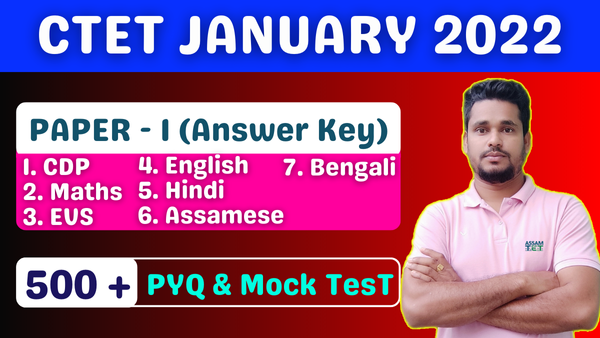
CTET Jan 2022 Paper 1 Question With Answer
Get comprehensive CTET January 2022 Paper 1 questions with detailed answers for Mathematics, EVS, Child Development & Pedagogy, Language 1, and Language 2. Ideal for exam preparation with solved solutions and expert explanations.
Get detailed CTET January 2022 Paper 1 questions with accurate answers. Access comprehensive solutions for Mathematics, EVS, Language 1 & 2, and Child Development & Pedagogy to boost your CTET exam preparation.
💠 Child Development and Pedagogy
💠 Mathematics / गणित
💠 Environment Studies
💠 Language - I : English
💠 भाषा - I : हिंदी
💠 Language - II : English
💠 भाषा - II : हिंदी
💠 Language - I : Assamese
💠 Language - I : Bengali
💠 Language - II : Assamese
💠 Language - II : Bengali
PART - I / भाग - I
Child Development and Pedagogy / बाल विकास और शिक्षणशास्त्र
Direction : Answer the following questions (Q. Nos 1 to 30) by selecting the correct/most appropriate options.
निर्देश : निम्नलिखित प्रश्नों (प्रश्न संख्या 1 से 30) के उत्तर सही/सबसे उपयुक्त विकल्पों का चयन करके दीजिए।
1. Which of the following is an example of use of gross motor skills?
A. Balancing on one foot
B. Squeezing a pea
C. Turning pages of a book
D. Holding a pencil
2. Development changes are a result of:
A. Unique combination of genetic and environmental circumstances.
B. Only genetic makeup of an individual.
C. Only socio-cultural factors.
D. Neither hereditary nor environmental factors.
3. The period from 2 years to 6 years is referred to as:
A. Infancy
B. Early childhood
C. Middle childhood
D. Adolescence
4. Assertion (A): A lot of children's play in the cities is based on reality T.V. shows that they see.
Reason (R): Apart from family and peers these days media is becoming an important agency of socialization of children.
Choose the correct options.
A. Both (A) and (R) are true and (R) is the correct explanation of (A)
B. Both (A) and (R) are true, but (R) is not the correct explanation of (A)
C. (A) is true, but (R) is false
D. Both (A) and (R) are false
5. Which of the following factors are considered important by Piaget to facilitate learning?
(i) Mobility of the teacher
(ii) Provisioning of diverse materials
(iii) Providing moderately novel experiences
(iv) Ensuring positive and negative reinforcement
A. (ii), (iv)
B. (i), (ii), (iii)
C. (i), (iii), (iv)
D. (i), (ii), (ii), (iv)
6. At which stage do children have an animistic view of the larger world and believe that the trees and plants as well as moving clouds and rolling stones can have motives and intentions?
A. Sensori-motor stage
B. Pre-operational stage
C. Concrete operational stage
D. Formal operational stage
7. Language plays an important role in the cognitive development of children in the theory of:
A. Lev Vygotsky
B. Jean Piaget
C. Howard Gardner
D. Lawrence Kohlberg
8. According to Vygotsky, children learn by:
A. Having competitions
B. Interaction with peers
C. Striving for rewards and avoiding punishments
D. Making stimulus-response connections
9. In a child-centered classroom children:
A. Are looked at as passive imitators.
B. Are actively engaged in construction of knowledge.
C. Are eager to copy answer from blackboard as it is.
D. Have to be passive listeners only.
10. Which of the following is a correctly matched pair?
A. Punishment and Obedience orientation - Laws are not fixed but can be changed for the good of the society.
B. Good-Boy Good- girl orientation - One earns approval by being nice.
C. Law and Order orientation - Ethical principles are self-chosen than on the basis of the value of human rights.
D. Social Contract orientation - Physical consequences of an action determine whether it is good/bad
11. In Howard Gardner's theory person high on intelligence can recognize and are aware of the beauty of different species of flora and fauna.
A. Spatial
C. Musical
B. Naturalistic
D. Inter-personal
12. National Education Policy 2020 recommends:
A. Multilingualism
B. Monolingualism
C. Standardization of curriculum
D. Standardization of assessment
13. A teacher holds the perception that boys are more intelligent and risk taking and girls are obedient and sincere and treats them accordingly. This is an example of:
A. Gender bias
C. Gender equity
B. Gender constancy
D. Gender equality
14. Assertion (A): Teachers should use a wide variety of assessment tools and technique to assess children.
Reason (R): No single assessment tool is capable of providing information about a child's progress and learning in different areas of development.
Choose the correct option.
A. Both (A) and (R) are true and (R) is the correct explanation of (A)
B. Both (A) and (R) are true, but (R) is not the correct explanation of (A)
C. (A) is true, but (R) is false
D. Both (A) and (R) are false
15. Which of the following situation does NOT illustrate assessment for learning?
A. Students actively think about where they are, where they are going and how to get there.
B. Teachers give constructive qualitative feedback to facilitate learning.
C. Constant comparisons are made between the students to enhance performance.
D. Several methods of formative assessment such as peer and self-assessment are used.
16. Inclusive Education requires:
A. Flexible pedagogies
B. Inaccessible building
C. Rigid mindsets
D. Standardized curriculum
17. Which of the following disability causes challenges in 'social communication'?
A. Autism
B. Dyscalculia
C. Dysgraphia
D. Locomotor disability
18. Which of the following helps in inclusion of learners from disadvantaged and deprived groups?
A. Consideration of diversity
B. Decontextualized curriculum
C. Pedagogy centered towards dominant group
D. Standardized testing
19. Provision of multiple modes of representation of content will help in inclusion of
(i) Students with hearing impairment
(ii) Students with visual impairment
(iii) Students facing learning difficulties
(iv) Students facing locomotor difficulties
A. (i)
B. (ii), (iii)
C. (i), (ii), (iv)
D. (i), (ii), (iii), (iv)
20. Which of the following is a correctly matched pair of appropriate accommodation strategy for inclusion of students which specified disability?
A. Dyscalculia - Provision of calculator
B. Dyslexia - Assigning lengthy written assignments
C. Hearing Impairment - Giving audio tapes
D. Visual Impairment - Providing picture books.
21. In early grades, which of the following approaches is preferable for teaching-learning process?
A. Imitation without understanding
B. Learning by doing
C. Passive listening
D. Rote-memorisation
22. Assertion (A): Participation in the social life of the school is significant for learning to occur.
Reason (R): Learning is primarily a social activity.
Choose the correct option.
A. Both (A) and (R) are true and (R) is the correct explanation of (A)
B. Both (A) and (R) are true, but (R) is not the correct explanation of (A)
C. (A) is true, but (R) is false
D. Both (A) and (R) are false
23. Teachers can make classroom activities meaningful by:
A. Dividing them in disconnected chunks
B. Giving ambiguous instructions about them
C. Presenting them in decontextualized manner
D. Situating them in the authentic context
24. Which of the following pedagogical practices does NOT contribute positively in teaching-learning process?
A. Curriculum adaptation as per needs
B. Experiential learning for students
C. Innovation in curricular planning
D. Rigid exam-centered teaching strategies
25. Assertion (A): A teacher should connect content to be taught with students' daily life experiences.
Reason (R): Children come to school with valuable life experiences that teachers need to pay attention to
Choose the correct option
A. Both (A) and (R) are true and (R) is the correct explanation of (A)
B. Both (A) and (R) are true, but (R) is not the correct explanation of (A)
C. (A) is true, but (R) is false
D. Both (A) and (R) are false
26. Which of the following helps learners evaluate their own learning and check their understanding?
A. Forgetting
C. Metacognition
B. Imitation
D. Rote-memorization
27. Misconception among children are:
A. Abnormal
B. Atypical
C. Natural
D. Rare
28. A student experiencing 'learned helplessness' is likely to:
A. Show enthusiasm in learning
B. Focus on mastery-oriented goals
C. Focus on performance-oriented approach goals
D. Withdraw from learning activities
29. Which of the following is an example of intrinsic motivation?
A. Learning a new language out of interest
B. Drawing a picture to win a cash prize
C. Participating in a sport to win an award
D. Studying to get praise of parents
30. Which of the following is an environmental factor which impact learning?
A. Attitude
B. Motivation
C. Personality traits
D. School
PART - I / भाग - I
Mathematics / गणित
Direction : Answer the following questions (Q. Nos 31 to 60) by selecting the correct/most appropriate options.
निर्देश : निम्नलिखित प्रश्नों (प्रश्न संख्या 31 से 60) के उत्तर सही/सबसे उपयुक्त विकल्पों का चयन करके दीजिए।
31. A square has a bounding of 16 cm. From each of the four corners of this square, a small square of side 1 cm is cut off. What will be the length of the boundary of the remaining figure?
A. 12 cm
C. 16 cm
B. 14 cm
D. 18 cm
32. What will come in the blank?
2 thirds + ......... = 11 twelfths
A. 9 thirds
B. 1 third
C. 3 twelfths
D. 13 twelfths
33. On her birthday Merlin's mother gave her a packet of toffees to toffees to share with her friends. Merlin gave 2/7th of toffees to Aditi, 1/6th to Amol, 2/5th to Farhan, and 1/7th to Jery. If she is left with only 2 toffees, then how many toffees were there in the packet.
A. 105
C. 315
B. 210
D. 420
34. A shopkeeper has some eggs. He wants to put them in trays which can have exactly 12 eggs. He filled 9 trays with eggs and left with 5 eggs. How many more number of eggs does he need so that no egg is left out after completing the 10th tray?
A. 5
C. 7
B. 6
D. 8
35. Savita went to ATM to withdraw some money. She got five notes of ₹ 2000, four notes of ₹ 500 and nine notes of ₹ 100. On counting she found that 1 note of ₹2000 and 1 note of ₹100 are less in the whole amount. How much amount did she enter for withdrawal?
A. 14000
C. 15000
B. 14500
D. 16500
36. Anu brought 2 kg 500 g Laddu, 3 kg 250 g Jalebi and 4 kg Rasgullas from a sweet shop. The shopkeeper packed everything together in boxes with a maximum capacity of 750 g. How many boxes required to pack all the items?
A. 15
B. 13
C. 14
D. 12
37. The four traffic lights of a cross road change after 30s, 45s, 1 minute and 75s respectively. If these lights changed simultaneously at 1:35 pm, then they will change simultaneously again at.
A. 2:05 pm
B. 1:50 pm
C. 2:10 pm
D. 1:55 pm
38. Rae and Reena have arranged the bricks horizontally one above the other. If the length, width and height of each bricks are 6 inches. 3 inches and 3 inches, respectively then how many rows of the bricks will be required to create a 3.5 meter wall?
A. 46
B. 58
C. 42
D. 64
39. Rama reads the following details on a packet before throwing it on 3rd July 2021.
Date of packing : 10th Jan 2021
Best before 180 days from the date of packing
Which of the following statement, is correct?
A. She should throw the packet as the date of expiry has been already crossed
B. She can still use the packet for almost one more week
C. She can wait for another six months as it will get expired after 180 days
D. The packet got expired on 10th June 2021 so she should throw it.
40. Teacher gave some objects to children that include a matchbox, a ball, a book, a steel glass and a rope. She asked them to identify the objects which have the most numbers of corners. Which of the following statements is correct for the above situation?
A. Rope should be selected as it is the longest among all the given objects
B. Book should be selected as it has more number of corners than the matchbox
C. Matchbox and book should be related as both of them can be classified in the same category of objects having edge, faces and corners
D. Ball should be selected as it has infinite corners
41. A closed shape made up of three or more than three line segments is called:
A. Triangle
C. Polygon
B. Quadrilateral
D. Polyhedrons
42. The temperature of a city is 23.5°C at 9 pm. If the temperature drops by 0.7°C every hour after that, then at what time the temperature will be 17.2°C?
A. 2:00 am
B. 3:00 am
C. 5:00 am
D. 6:00 am
43. Which of the following statements is true for the mean and median of the scores
15, 8, 13, 1, 23, 15, 20, 1
A. Mean is greater than the median
B. Median is greater than the mean
C. Both mean and median are equal
D. Median cannot be determined as there are even number of scores
44. The angles of rotations (rotational symmetry) of an equilateral triangle are:
A. 90°, 180°, 270°, 360°
B. 60°, 120°, 180°
C. 120°, 240°, 360°
D. 60°, 120°, 180°, 240°, 300°, 360°
45. Identify the next term of the given pattern
IZA, 4YB, 9XC, 16WD, .........
A. BIVE
C. 25EV
B. 25VE
D. SIEV
46. Which of the following is NOT a stage/level of Van Hiele theory of geometrical reasoning?
A. Visualization
B. Concrete operation
C. Analysis
D. Axiomatic
47. "Continuous and comprehensive evaluation in mathematics would include:
(a) Detailed feedback on the students conceptual understanding
(b) Only the collective progress of the class in terms of percentage of students failed or passed
(c) Progress of the students throughout the year
(d) Minimum levels of learning in mathematics
Choose the correct options:
A. (b) and (d)
B. (a), (b) and (d)
C. (a) and (c)
D. only (b)
48. Which of the following statements is NOT true about mapping in mathematics?
A. Mapping forms the basis for many topics in higher mathematics
B. Mapping strengthens spatial thinking
C. Mapping promotes proportional thinking
D. Mapping only includes drawing of a map of one's surroundings
49. Which of the following is a closed ended question?
A. List five-3-digit numbers that have digit 5 at the tens place
B. Draw a shape where the sum of all sides is 36 cm
C. Write five whole numbers between 178 and 184
D. List two sets of five numbers that have a sum of 50
50. Which of the following is NOT a type and utility of numbers?
A. Cardinal numbers.
B. Ordinal Numbers.
C. Aesthetic Numbers.
D. Nominal Numbers
51. While teaching about measurement of length, a teacher asked the students to measure their table using hand spans and paper clips instead of measuring directly by a scale. What is the most appropriate reason for during this activity?
A. She wants to engage the children in hands-on activity because it is interesting for students.
B. She wants her students to learn how to measure length correctly using paper clips.
C. She wants her students to practice old ways of measurements using objects.
D. She wants the students to understand the need for standard units for measurement.
52. A primary school mathematics teacher asked the students to take out "Ruler' as she was going to teach the topic on length measurement. Students got confused how can they take out a king or queen. Such words are called Homonyms. How can teachers address this challenge in classroom?
A. By asking the English language teacher to teach the word meanings of such words in English class
B. Teacher should draw the attentions of students to the specific meaning being used in mathematical context whenever such words appear in teaching.
C. Teacher should prepare a list of such words with their meanings and ask students to memories them.
D. Teacher should ignore this as students eventually would learn many such words when they would practice more question.
53. A class III teacher reads out the following problem to her students
"If I subtract '2 ones' from '2 tens' what will be the answer"
One students responded the answer is zero.
Which of the following statement is correct for the above context?
A. The answer given by the student is correct
B. Teacher should use concrete materials to strengthen the concept of place value in student
C. Teacher should give 10 similar problems to practice
D. Teacher should ignore the response of the student and should herself give the right answer and move to next problem to solve
54. While planning a lesson on the concept of addition of fractions a teacher is using the activity of rectangular strip folding. The above activity is a:
A. Content activity
B. Post content activity
C. Pre content activity
D. Wastage of time
55. Which one of the following is the most important characteristic of a good mathematics text book at primary level?
A. Concepts should be introduced through contexts
B. It should only contain numerous questions for practice
C. It should be attractive and colourful
D. Concepts should be introduced through formal algorithms
56. The National curriculum framework (2005) considers that mathematics involves 'a certain way of thinking and reasoning'. The vision can be realized by:
A. Giving special coaching to students
B. Adopting exploratory approach, use of manipulatives connecting concepts to real life, involving students in discussions
C. Rewriting all the text book of mathematics
D. Emphasizing on solving problems given in text book
57. As a mathematics educator what advice will you give to prospective teachers to improve children's performance in mathematics.
A. Get children as many books as possible for practice work
B. Advice parents for tutoring children at home
C. Help children make connections between conceptual and procedural knowledge
D. Plan remedial classes for children at the end of the year
58. The statement Teacher acts as a Facilitator, helps students to discover relationships and seek pattern for themselves is most suited with:
A. Role play
C. Analytical method
B. Inductive method
D. Demonstration
59. A primary class teacher asks his students to collect data on number of boys and girls studying in class V in their neighborhood (including at least five households). Which of the following most appropriately describes the purpose of this activity?
A. To make students aware of gender differences in their neighborhood
B. To introduce the topic of data handling
C. To make children familiar with their community
D. To give holiday home work to students
60. Which of the following is NOT one of the steps of problem solving given by Polya.
A. Understanding the problem
B. Devise a Plan
C. Recreate the plan
D. Carry out the plan
PART - III / भाग - III
Environment Studies / पर्यावरण अध्ययन
Direction : Answer the following questions (Q. Nos 61 to 90) by selecting the correct/most appropriate options.
निर्देश : निम्नलिखित प्रश्नों (प्रश्न संख्या 31 से 60) के उत्तर सही/सबसे उपयुक्त विकल्पों का चयन करके दीजिए।
61. Crocodiles are mainly killed by poachers
A. For horns
C. For teeth
B. For skin
D. or scent
62. Bora is a common variety of 'glutinous' rice. It is mainly found in:
A. In Assam
B. In Bihar
C. In Odisha
D. In Tamil Nadu
63. In winters, grandmothers often use a solution of the following to protect the kin from dryness:
A. Rose water and distilled water
B. Rose water, glycerin and lemon juice
C. Lemon juice and milk
D. Rose water and vinegar
64. A bird that makes a nest hanging from the branch of a small tree or shrub is:
A. Sun bird
B. Crow
C. Barbet
D. Indian Robin
65. PNR on train ticket shows:
A. Passenger number record
B. Passenger name record
C. Personal name record
D. Personal number record
66. In Malayalam mother's elder sister is called as:
A. Valliamma
B. Ammumma
C. Themma
D. Didu
67. Which one of the following places is in Kerala?
A. Valsad
B. Kozhikode
C. Udupi
D. Malakheda
68. The village got its name from the many khejri trees growing there. The people of this village take great care of the plants, trees and animals. In India this village is:
A. In Uttarakhand
B. In Uttar Pradesh
C. In Rajasthan
D. In Maharashtra
69. The head of a herd of elephants is:
A. Smallest female elephant
B. Oldest female elephant
C. Largest male elephant
D. Smallest male elephant
70. Pottery is made strong:
A. By baking
B. By smelting
C. By roasting
D. By burning
71. The part of the plant that can be used for the treatment of toothache?
A. Fennel
B. Clove
C. Fenugreek
D. Poppy seeds
72. Identify the correct sequence of making 'Chapati' from wheat flour.
A. Kneading flour into a dough, making small balls of the dough, rolling out the balls and then cooking it on fire.
B. Making small balls of the dough, kneading flour into a dough, rolling out the balls and then cooking it on fire.
C. Making small balls of the dough, rolling out the balls, kneading flour into a dough and cooking it on fire.
D. Kneading flour into a dough, rolling out the balls and making small balls of the dough and cooking it on fire.
73. In dance the main poses and expressions demonstrates:
A. Dance performance
B. Feelings
C. Confidence
D. Hand and face movements
74. Children who cannot speak and hear, they learn?
A. Through sign language
B. Through native language
c. Through their local language
D. Through braille
75. Which of the following is different from others? River, mountain, lake, pond, spring
A. River
C. Lake
B. Mountain
D. Spring
76. Which of the following indicates the child centred nature of Environmental Studies at primary level
(a) Children's life at school must be linked to their life outside the school
(b) Discourage rote learning
(c) Departure from bookish learning
(d) Having sharp boundaries among school, home and the community for the learning
A. (a) and (b) only
B. (a) and (c) only
C. (a), (b) and (c) only
D. (b) and (d) only
77. Which of the following can be the objective of Environmental Studies at primary level
(a) Encouraging children to reflect on their own learning
(b) Engaging children by giving space, time and freedom to generate new knowledge.
(c) Treating children as participants in learning, not as receivers of a fixed body of knowledge.
(d) Treating the prescribed textbook as the sole basis of resources for learning.
A. (a), (b) and (c) only
B. (a), (c) and (d) only
C. (b), (c) and (d) only
D. (c) and (d) only
78. Which of the following statements is true in relation to Environmental Studies at primary level?
A. Environmental Studies (EVS) in Classes III to Vas a subject integrates the concepts and issues of science, social science and environment education.
B. This subject is there in classes I and II and issues and concerns related to it are given through Language and Mathematics.
C. The language used in the EVS textbooks are formal.
D. It is based on a single subject approach
79. Which one of the following should be minimized in the EVS classroom?
A. Free debates
C. Narratives
B. Picture reading
D. Descriptions
80. Real challenge for EVS learning at primary level is:
A. Definitions and information
B. Rote learning
C. Descriptions of concepts
D. Opportunities for children's to express themselves
81. Which of the following themes consists of subthemes in the syllabus of EVS at primary level?
A. Family and friends
B. Water
C. Work and play
D. Food
82. Authentic and meaningful given through: learning of EVS can he
(a) Narratives
(b) Real dialogues
(c) Process of experimentations
(d) Assessment of answer given by students as right and wrong
A. (a), (b) and (d) only
B. (c) and (d) only
C. (b), (c) and (d) only
D. (a), (b) and (c) only
83. Issues of theme "travel" can only be meaningful for the students:
A. If debates are conducted around the issues
B. If audio-visuals are shown to students
C. If demonstrations are given by teachers
D. Theme based worksheets are given to students
84. Besides EVS textbooks, which one of the following may be a good resource for EVS learning?
A. Field visits
B. Radio
C. Wikipedia
D. Encyclopedia
85. Socio-cultural issues related to Water Theme can be effectively learnt through
(a) Role-play
(b) Real dialogue among students
(c) Field trip
(d) Demonstration and home work
A. (a), (b) and (c) only
B. (c) and (d) only
C. (d) only
D. (c) only
86. EVS textbook contain real stores, narratives and real events for the learning of EVS because:
(a) They are rich source of information and learning.
(b) They inspire students, teachers and the community.
(c) They can provide us an opportunity to revisit experiences we are familiar with.
(d) They make the pedagogy of EVS easy for the teachers
A. (d) only
B. (b) only
C. (c) only
D. (a), (b) and (c) only
87. For consolidating the assessment should be on: learning of EVS, focus of
A. For learning
B. Of learning
C. As learning
D. Informal learning
88. Raja, an EVS teacher uses an assessment tool that clearly indicates achievement criteria across all the components of students' work from written to oral to visual. Teacher is using:
A. Rubrics
C. Anecdotal record
B. Check list
D. Observation sheet
89. Self-assessment in EVS is:
(a) Assessment as learning
(b) Learning about learning
(c) Judgements about achievements and the outcome of learning.
(d) Assessment of learning.
A. (a), (b) and (c) only
C. (a) and (c) only
B. (c) only
D. (a), (c) and (d) only
90. Learning of EVS is based on the principle of:
A. Simple to complex
B. Complex to simple
C. Global to local
D. Abstract to concrete
PART - IV
Language - I : English
IMPORTANT : Candidates should attempt questions from Part-IV (Q. No. 91 - 120), if they have opted for ENGLISH as LANGUAGE - I only.
Directions (Qs. No. 91-99): Read the passage given below and answer the questions that follow by choosing the correct/most appropriate options.
The Ganga is the lifeblood of hundreds of millions of people in India and Bangladesh. Every day, they depend on its water for drinking, cooking and washing. Farmers rely on the river for water for their crops. Hindus worship the Ganges as a Goddess named Ganga. Yet this river is threatened by pollution and by the increasing water demands of industries, cities and a growing population.
The Ganga begins in the Himalayas, the highest mountain range in the world. The river flows southeast across the plains of Northern India. It enters Bangladesh and is joined by the Brahmaputra river and the Meghana river. There the river's name changes to the Padma river. It forms a delta 220 miles (350 km) wide, which is shared by India and Bangladesh. Finally, the river empties into the Bay of Bengal.
In comparison with many other major world rivers, the Ganga is short, with a length of about 1,560 miles (2,150 km) for most of its course, the river is wide and its waters are slow-moving.
The main sources of the Ganga are Bhagirathi and the Alaknanda. The water in these rivers comes from glaciers high in the Himalayas. Melting glacial ice sustains the Ganga and its tributaries.
Monsoon plays a major role in the life of the Ganga river and in the lives of the people who live along its banks. The monsoon can cause terrible floods in the Ganga delta region. From its mountain source to its wide delta, the Ganga flows through a variety of ecosystems.
91. Which of the following statements is not true in the light of the passage above?
A. The Ganga runs wide for most of its course
B. It supports diverse eco-systems
C. Glaciers melt directly into the Ganga
D. The Ganga water depends much on the monsoon rains
92. Which of the following words is similar in meaning to the word, 'rely' as used in the passage? (para 1)
A. expect
C. submit
B. depend
D. promote
93. Which part of the speech is the underlined word in the sentence given below?
"It then enters Bangladesh and is joined by the Brahmaputra and the Meghana river".
A. Adjective
C. Adverb
B. Conjunction
D. Preposition
94. The greatest human challenge to the Ganga is:
A. growing population, industries and pollution
B. erratic monsoon
C. uncontrolled tributaries
D. agricultural dependence
95. The Ganga river is described as the "lifeblood" of people because:
A. people depend on the river for sustenance and survival
B. it is a holy river
C. it springs from the Himalayas
D. it is one of the oldest rivers of the country
96. The Ganga can be called a "Shared river" because:
A. it connects countries and weaves different civilizations together
B. it flows into the ocean and mingles with other waters
C. it is more beneficial to Bangladesh than India
D. it emerges out of the mountain ranges of the great Himalayas
97. The name of the Ganges changes to Padma river when
A. enters the Bay of Bengal
B. enters Bangladesh and is joined by the Brahmputra River and the Meghana river
C. flows through the plains Northern India
D. finally merges into the unknown seas
98. Which of the following is opposite in meaning to the word 'major' as used in the passage? (para 5)
A. unimportant
C. minor
B. insignificant
D. medicine
99. Which part of the following sentence contains an error?
(a) The car
(b) is in
(c) remarkably good condition
(d) of its age
A. (b)
B. (c)
C. (d)
D (a)
Directions (Qs. No. 100-105): Read the poem given below
The crucified planet Earth
Should it find a voice
and a sense of irony,
might now well say
of our abuse of it,
"Forgive them Father,
They know not what they do"
The irony would be that we know what
we are doing.
When the last living thing
has died on account of us,
how poetical it would be
If Earth could say,
in a voice floating up
perhaps
from the floor
of the Grand Canyon
"It is done"
People did not like it here.
100. Who is the speaker of the line, "Forgive them, Father, they know not what they do" in the above poem?
A. The Earth
B. People
C. The heavens
D. The planets
101. Identify and name the figure of speech used in 'Crucified Earth'?
A. Personification
B. Conceit
C. Allegory
D. Paradox
102. A sense of destructive fear pervades the poem. What prompts the poet to signal this note on apocalypse?
A. People did not like being on Earth
B. Earth itself no longer welcomes humans
C. God did not grant them forgiveness
D. Man has recklessly ruined and exploited nature
103. Which of the following is not true according to the extract?
A. We do not know what we are doing
B. We are destroying what sustains us
C. We are waiting for a saviour
D. We are too naive to understand the implications of our actions
104. "People did not like it here" is an example of
A. hyperbole
B. sarcasm
C paradox
D. metonymy
105. According to the poet, if the Earth is given a chance for any utterance, what would it say to God?
A. Stop the extinction of mankind
B. Forgive the wrongful deeds of men
C. Fix responsibility for the mindless destruction of the Earth
D. Give people the strength to resist temptation
106. Which one of the following is the highest level of writing skill?
A. Correct spelling
B. Digraph writing
C. Articles writing
D. Using difficult words in Sentences
107. Being a language teacher, you would like to adopt which form of the content?
A. Concrete descriptive and analytical
B. Abstract descriptive and analytical
C. Concrete descriptive and Conceptual
D. Abstract Conceptual and Conceptual
108. According to the Piaget, the process of language acquisition is:
A. Associative
B. Matching
C. Strategic
D. Social
109. A student whose home language and School language are different, how can you, as a teacher, help as a resource?
A. By giving him extra attention in class
B. Using multilingualism as resource in the classroom
C. By giving him flexibility in homework related work
D. By teaching in the class in his mother tongue
110. Consider the Statement (a) and (b) regarding Translanguaging.
(a) Translanguaging is a flexible form of multi- lingualism.
(b) Translanguaging is switching between the languages one known in order to maximize communicative potential.
A. (a) is true, (b) is false
B. (a) is false, (b) is true
C. Both (a) and (b) are true
D. Both (a) and (b) are false
111. What is used as a tool for learning language in whole language approach?
A. Actions
C. Nursery rhymes
B. Literature
D. Toys
112. The central role in total physical response is of:
A. Teacher
B. Parents
C. Family
D. Student
113. What is meant by 'reading skills on the basis of National Curriculum Framework (NCF) 2005
A. Correct pronunciation
B. Reading Syllables
C. Reading with understanding
D. Reading difficult sentences
114. What is the educational aspect of a language textbook?
A. Spelling of Book
B. Place of picture in Book
C. Selection of Content
D. Beautiful content with picture typography
115. Consider the activities assigned to the students. Which of the following activities should you try out to develop communication skills
(i) He (is/are) on actor.
(ii) On the weekend, I'm going to in the morning and will return by 5 pm in evening.
(iii) Ask your friend where he/she likes to visit on weekend and why.
(iv) Ask your classmate two points which she/he considers while group discussion.
A. (i), (ii), (iii)
C. (i), (ii)
B. (ii), (iii)
D. (iii), (iv)
116. According to Krashen, is a subconscious process.
A. Learning
B. Acquisition
C. Listening
D. Communication
117. According to Vygotsky, children who make extensive use of............. learn complex tasks more effectively than the other children.
A. Inner speech
B. Individual speech
C. Private speech
D. Silent speech
118. According to Jean Piaget, a language develops from 10 speech.
A. Private to individualized
B. Private to socialized
C. Egocentric to socialized
D. Socialized to egocentric
119. During classroom discussion, a class VI student is presenting his/her own perspective over 'causes of corruption'. Neither he/she is convinced with other's ideas nor is he/she trying to look from other's perspective. Hence, according to Piaget, in which type of speech is he/she involved in?
A. Ego-centric speech
B. Social speech
C. Individual speech
D. Private speech
120. In order to make the students understand the grammatical structures, a language teacher should:
A. Provide rich written material and let the students discover different structures.
B. Provide extensive grammatical exercises to the students.
C. Ask students to memorise structures from the book,
D. Give an assignment to the students over different structures
भाग - IV
भाषा - I : हिंदी
महत्वपूर्ण : परीक्षार्थी भाग IV (प्र.सं. 91 से 120) के प्रश्नों के उत्तर केवल तभी दें यदि उन्होंने भाषा - I का विकल्प हिन्दी चुना हो।
Translate (AI) = English To Hindi Version
106. निम्नलिखित में से लेखन कौशल का सबसे उच्च स्तर कौन-सा है?
A. सही वर्तनी
B. संयुक्ताक्षर लेखन
C. लेख लेखन
D. वाक्यों में कठिन शब्दों का उपयोग
107. एक भाषा शिक्षक के रूप में, आप सामग्री के किस प्रकार को अपनाना चाहेंगे?
A. ठोस, वर्णनात्मक और विश्लेषणात्मक
B. अमूर्त, वर्णनात्मक और विश्लेषणात्मक
C. ठोस, वर्णनात्मक और अवधारणात्मक
D. अमूर्त, अवधारणात्मक और अवधारणात्मक
108. पियाजे के अनुसार, भाषा अधिग्रहण की प्रक्रिया:
A. सहायक है
B. मिलान है
C. रणनीतिक है
D. सामाजिक है
109. एक ऐसा छात्र जिसकी घरेलू भाषा और स्कूल भाषा अलग हैं, एक शिक्षक के रूप में आप कैसे उसे संसाधन के रूप में सहायता कर सकते हैं?
A. कक्षा में उसे अतिरिक्त ध्यान देकर
B. कक्षा में बहुभाषावाद को संसाधन के रूप में उपयोग करके
C. उसे होमवर्क से संबंधित कार्यों में लचीलापन देकर
D. कक्षा में उसकी मातृभाषा में पढ़ाकर
110. ट्रांसलैंग्वेजिंग के संबंध में निम्न कथन (a) और (b) पर विचार करें।
(a) ट्रांसलैंग्वेजिंग बहुभाषावाद का एक लचीला रूप है।
(b) ट्रांसलैंग्वेजिंग का मतलब संचार की अधिकतम क्षमता के लिए जानी हुई भाषाओं के बीच स्विच करना है।
A. (a) सही है, (b) गलत है
B. (a) गलत है, (b) सही है
C. (a) और (b) दोनों सही हैं
D. (a) और (b) दोनों गलत हैं
111. संपूर्ण भाषा दृष्टिकोण में भाषा सीखने के लिए किसका उपयोग किया जाता है?
A. क्रियाएं
B. साहित्य
C. नर्सरी कविताएं
D. खिलौने
112. शारीरिक प्रतिक्रिया में मुख्य भूमिका किसकी होती है?
A. शिक्षक
B. माता-पिता
C. परिवार
D. छात्र
113. राष्ट्रीय पाठ्यचर्या ढांचे (NCF) 2005 के आधार पर 'पढ़ने के कौशल' का क्या अर्थ है?
A. सही उच्चारण
B. शब्दांश पढ़ना
C. समझ के साथ पढ़ना
D. कठिन वाक्य पढ़ना
114. एक भाषा पाठ्यपुस्तक का शैक्षिक पहलू क्या है?
A. पुस्तक की वर्तनी
B. पुस्तक में चित्रों का स्थान
C. सामग्री का चयन
D. सुंदर सामग्री के साथ चित्रों की टाइपोग्राफी
115. छात्रों को सौंपे गए कार्यकलापों पर विचार करें। निम्नलिखित में से कौन-सी गतिविधियां आप संचार कौशल विकसित करने के लिए आजमाएंगे?
(i) वह (है/हैं) एक अभिनेता।
(ii) सप्ताहांत में, मैं सुबह जाने वाला हूं और शाम 5 बजे तक लौटूंगा।
(iii) अपने मित्र से पूछें कि वह सप्ताहांत में कहां जाना पसंद करता/करती है और क्यों।
(iv) अपने सहपाठी से पूछें कि वह समूह चर्चा के दौरान किन दो बिंदुओं पर विचार करता/करती है।
A. (i), (ii), (iii)
B. (ii), (iii)
C. (i), (ii)
D. (iii), (iv)
116. क्रैशेन के अनुसार, ........... एक अचेतन प्रक्रिया है।
A. सीखना
B. अधिग्रहण
C. सुनना
D. संवाद
117. वायगोत्स्की के अनुसार, वे बच्चे जो ............ का व्यापक उपयोग करते हैं, वे अन्य बच्चों की तुलना में जटिल कार्यों को अधिक प्रभावी ढंग से सीखते हैं।
A. आंतरिक भाषा
B. व्यक्तिगत भाषा
C. निजी भाषा
D. मौन भाषा
118. जीन पियाजे के अनुसार, भाषा ........... से विकसित होती है।
A. निजी से व्यक्तिगत
B. निजी से सामाजिक
C. आत्मकेंद्रित से सामाजिक
D. सामाजिक से आत्मकेंद्रित
119. कक्षा चर्चा के दौरान, कक्षा 6 का एक छात्र 'भ्रष्टाचार के कारणों' पर अपना दृष्टिकोण प्रस्तुत कर रहा है। वह न तो दूसरों के विचारों से सहमत है और न ही दूसरों के दृष्टिकोण से देखने की कोशिश कर रहा है। अतः, पियाजे के अनुसार, वह किस प्रकार की भाषा में संलग्न है?
A. आत्मकेंद्रित भाषा
B. सामाजिक भाषा
C. व्यक्तिगत भाषा
D. निजी भाषा
120. छात्रों को व्याकरणिक संरचनाएं समझाने के लिए एक भाषा शिक्षक को क्या करना चाहिए?
A. समृद्ध लिखित सामग्री उपलब्ध कराएं और छात्रों को विभिन्न संरचनाओं की खोज करने दें।
B. छात्रों को व्यापक व्याकरणिक अभ्यास दें।
C. छात्रों को पुस्तक से संरचनाएं रटने के लिए कहें।
D. छात्रों को विभिन्न संरचनाओं पर एक असाइनमेंट दें।
PART - V
Language - II : English
IMPORTANT : Candidates should attempt questions from Part - V (Q. No. 121 - 150), if they have opted for ENGLISH as LANGUAGE - II only.
Translate (AI) = Hindi To English Version
136. Consider (a) and (b) regarding the dialectal characteristics of a language:
(a) The prominence of sound is not just what you say, but how you say it.
(b) Intonation means variation in voice or speech.
A. (a) is correct, (b) is incorrect
B. (a) is incorrect, (b) is correct
C. Both (a) and (b) are correct
D. Both (a) and (b) are incorrect
137. What is the language first acquired by a child with the help of family members called?
A. First language
B. Second language
C. Regional language
D. Foreign language
138. If students in a class use a limited vocabulary during communication, what is the best way to expand their vocabulary?
A. Ask students to create a list of synonyms and antonyms of words they use during communication.
B. Encourage students to read more books and write down words from them.
C. Ask students to read aloud the text two or three times a day.
D. Encourage students to engage in group discussions and allow them to replace words with new ones during communication.
139. Despite its complexity, language is acquired with the help of innate grammatical knowledge. This idea is related to the theory proposed by whom?
A. Stephen Krashen
B. Noam Chomsky
C. Lev Vygotsky
D. Jean Piaget
140. When children either talk to themselves or for the pleasure of someone involved in the ongoing activity, what type of speech are they engaging in?
A. Social speech
B. Private speech
C. Egocentric speech
D. Individual speech
141. Consider (a) and (b) :
(a) Language is connected to the thinking process.
(b) Language helps in practicing the structure and functions of conversation.
A. (a) is correct, (b) is incorrect
B. (a) is incorrect, (b) is correct
C. Both (a) and (b) are correct
D. Both (a) and (b) are incorrect
142. According to Vygotsky, when does language development in children occur?
A. When they interact with others.
B. When they interact with physical objects.
C. When they interact with themselves.
D. When they remain silent.
143. Which of the following statements does NOT apply to Noam Chomsky's theory of language acquisition?
A. Deep structure of language
B. Transformational grammar
C. Language acquisition device
D. The primary role of the child's environment
144. Match the following:
| Column A | Column B |
| (a) Input hypothesis | (i) James Asher |
| (b) Total physical response | (ii) Prabhu |
| (c) Task-based language teaching | (iii) Stephen Krashen |
| (d) Language and brain | (iv) Noam Chomsky |
A. (a)-(ii), (b)-(iv), (c)-(iii), (d)-(i)
B. (a)-(iii), (b)-(ii), (c)-(i), (d)-(iv)
C. (a)-(iv), (b)-(iii), (c)-(ii), (d)-(i)
D. (a)-(iii), (b)-(i), (c)-(ii), (d)-(iv)
145. Which of the following statements is correct according to Piaget?
A. Thought precedes language.
B. Language precedes thought.
C. Language and thought are two independent concepts.
D. Language and speech merge around the age of three years.
146. A teacher asks students to follow these steps while reading a passage: Find or write a title sentence for each paragraph or section; identify the main ideas encompassing several specific points; obtain some supporting details for each main idea; eliminate unnecessary information or details. What strategy is the teacher using?
A. Identifying
B. Summarizing
C. Predicting
D. Clarifying
147. A teacher uses intensive oral interaction in the target language for practicing it. What is this method called?
A. Natural method
B. Classical method
C. Bilingual method
D. Audio-lingual method
148. Choose the odd statement about the interactional model of language:
A. Language as a means of building mutual understanding of relationships.
B. Language as a medium for interpersonal social transactions.
C. Language as a means of delivering and receiving authentic messages.
D. Language as a tool to establish the relationship between grammar and vocabulary.
149. Rohini wants to present subject matter to fifth-grade students. Which points should she consider?
(i) Use of teaching activities (gap in communication and information).
(ii) Demonstrating formal, interactive, and other aspects of the target language.
(iii) Providing appropriate support where necessary.
(iv) Attempting to develop a habit of drilling.
A. (i), (ii), (iii)
B. (i), (ii), (iv)
C. (i), (iii)
D. (ii), (iv)
150. A language teacher wants to assess the performance of students in a group project. What should be the basis for evaluating individual performance?
A. Based on the performance of peers of the same age.
B. Based on each student's own previous level.
C. Based on the level of group performance.
D. Using the same criteria for everyone.
भाग - V
भाषा - II : हिंदी
महत्वपूर्ण : परीक्षार्थी भाग V (प्र.सं. 121 से 150) के प्रश्नों के उत्तर केवल तभी दें यदि उन्होंने भाषा - II का विकल्प हिन्दी चुना हो।
निर्देश (प्र.सं. 121 से 128): दिए गए गद्यांश को पढ़कर पूछे गए प्रश्न के लिए सबसे उपयुक्त विकल्प का चयन कीजिए।
एक आदमी ने घृणा से एक तरफ थूकते हुए कहा, "क्या जमाना है। जवान लड़के को मरे पूरा दिन नहीं बीता और बूढ़ी औरत दुकान लगा के बैठी है।" दूसरे साहब अपनी दाढ़ी खुजाते हुए कह रहे थे, "अरे जैसी नीयत होती है अल्ला भी वैसी ही बरकत देता है"।
सामने के फुटपाथ पर खड़े एक आदमी ने दियासलाई की तीली से कान खुजाते हुए कहा, "अरे इन लोगों का क्या है? ये लोग रोटी के टुकड़े पर जान देते हैं।" परचून की दुकान पर बैठे लाला जी ने कहा, "अरे भाई, उनके लिए मरे-जिए का कोई मतलब न हो, पर दूसरे के धर्म ईमान का तो ख्याल करना चाहिए। जवान बेटे के मरने पर तेरह दिन का सूतक होता है और वह यहाँ सड़क पर बाजार में आकर खरबूजे बेचने बैठ गई है। हजार आदमी आते-जाते हैं। कोई क्या जानता है कि इसके घर में सूतक है। कोई इसके खरबूजे खा ले, तो उसका ईमान-धर्म कैसे रहेगा? क्या अँधेर है!"
पास-पड़ोस की दुकानों से पूछने पर पता लगा उसका तेईस बरस का जवान लड़का था, घर में उसकी बहू और पोता-पाती हैं। लड़का शहर के पास डेढ़ बीधा भर जमीन में कछियारी करके परिवार निर्वाह करता था। खरबूजों की डलिया बाजार में पहुंचाकर कभी लड़का स्वयं सौदे के पास बैठ जाता, कभी माँ बैठ जाती।
तड़का परसों सुबह मुँह अँधेरे बेलों में से पके खरबूजे चुन रहा था। गीली मेंड़ की तरावट में विश्राम करते हुए एक साँप पर लड़के का पैर पड़ गया। साँप ने लड़के को इस लिया।
लड़के की बुढ़िया माँ बावली होकर ओझा को बुला जाई। झाड़ना- फूंकना हुआ। नागदेव की पूजा हुई।
121. परचून की दुकान का आशय है:
A. दवाइयों की दुकान
B. आटा-दाल आदि की दुकान
C. खिलौनों की दुकान
D. कपड़ों की दुकान
122. लोगों ने बुढ़िया के दुकान लगाने पर कटाक्ष क्यों किया?
A. बेटे की मृत्यु के उपरांत भी दुकान लगाई
B. बेटे की मृत्यु पर शोक सभा नहीं बुलाई
C. बेटे की मृत्यु पर पर में चूल्हा जलाया
D. बेटे की मृत्यु पर भोज का आयोजन नहीं किया
123. बुढ़िया के बेटे की मृत्यु का कारण थाः
A. गीली भेड़ पर फिसलना
B. गिरकर बेहोश हो जाना
C. साँप का इसना
D. खेत में करंट का सपना
124. बुढ़िया ने ओझा को क्यों बुलाया?
A. साँप को खोजकर मारने के लिए
B. साँप की पूजा-अर्चना करने के लिए
C. साँप के जहर की दवाई देने के लिए
D. सौंप का जहर उतारने के लिए
125. स्त्रीलिंग शब्द नहीं है:
A. तरावट
B. पानी
C. सड़क
D. घृणा
126. शहर में खरबूजे बेचने का काम कौन करता था?
A. केवल बेटा
B. केवल माँ
C. बेटा और माँ दोनों
D. बेटा और बहू
127. 'क्या अँधेर है।' वाक्य में रेखांकित शब्द से तात्पर्य है:
A. सही बात
B. झूठी बात
C. गलत बात
D. कड़वी बात
128. बाजार से जुड़ा शब्द नहीं है:
A. दुकान
B. सौदा
C. तरावट
D. बरकत
निर्देश (प्र.सं. 129 से 135) दिए गए गद्यांश को पढ़कर पूछे गए प्रश्नों के लिए सबसे उपयुक्त विकल्प का चयन कीजिए।
जुलाई से अक्टूबर, घनघोर बारिश के महीने। वानी लोगों के पास बहुत सारा खाली वक्त या कहो आसपास के जंगलों से बॉस इकट्ठा करने का सही वक्त। आमतौर पर वे एक से तीन साल की उम्र वाले बाँस काटते हैं। बूढ़े बाँस सख्त होते हैं और टूट भी तो जाते हैं। बाँस से शाखाएँ और पत्तियाँ अलग कर दी जाती हैं। इसके बाद ऐसे बाँसों को चुना जाता है जिसमें गठिं दूर-दूर होती हैं। दाजओ यानी चौड़े, चाँद जैसे फाल वाले चाकू से इन्हें छीलकर खपच्चियों तैयार की जाती हैं। खपच्चियों की लम्बाई पहले से ही तय कर ली जाती है। मसलन, आसन जैसी चीजें बनाने के लिए बाँस को हरेक गठान से काटा जाता है लेकिन टोकरी बनाने के लिए हो सकता है कि दो या तीन या चार गठानों वाली लम्बी खपच्चियों काटी जाएँ। यानी कहाँ से काटा जाएगा यह टोकरी की लम्बाई पर निर्भर करता है।
आमतौर पर खपच्चियों की चौड़ाई एक इंच से ज्यादा नहीं होती है। चौड़ी खपस्वियों किसी काम की नहीं होतीं। इन्हें चीर कर पतत्ती खपच्चियों बनाई जाती हैं। पतली खपच्विाँ लचीली होती हैं। खपच्चियों चीरना उस्तादी का काम है। हाथों की कलाकारी के बिना खपच्चियों की मोटाई बराबर बनाए रखना आसान नहीं। इस हुनर को पाने में काफी समय जगता है।
टोकरी बनाने से पहले खपच्चियों को चिकना बनाना बहुत जरूरी है। वहाँ फिर दाजो काम आता है। खपच्ची बाएँ हाथ में होती है और दाओ दाएँ हाथ में।
129. गद्यांश में मुख्य रूप से वर्णन है:
A. बाँस से बनने वाली चीजों का
B. बाँस को भिन्न तरह से काटने का
C. खपच्चियों की लम्बाई का
D. खपच्ची काटने में होने वाले खतरे का
130. 'दाओ' है:
A. एक प्रकार का बाँस
B. एक प्रकार का चाकू
C. एक प्रकार के लोग
D. एक प्रकार की खपच्ची
131. 'पतली खपच्चिर्यों लचीली होती हैं' में 'पतली' में विशेषण है:
A. संख्या बोधक विशेषण
B. गुण बोधक विशेषण
C. परिणाम बोधक विशेषण
D. सार्वनामिक विशेषण
132. गद्यांश में खपच्चियों को चिकना बनाने में प्रयोग किया जाता है:
A. दाजो
B. मसलन
C. आसन
D. उस्तादी
133. 'छपच्चियों चीरना उस्तादी का काम है' वाक्य में ........... भाव निहित है।
A. तकनीक और कला का
B. कला और सौंदर्य का
C. तकनीक और खतरे का
D. खतरे और सावधानी का
134. 'चौद' का पर्यायवाची नहीं है:
A. मयंक
C. विज्ञ
B. राशि
D. राकेश
135. बाँस का सामान बनाने के लिए ............ खपच्चियों का प्रयोग किया जाता है।
A. मोटी
C. चौड़ी
B. पतली
D. पुरानी
136. किसी भाषा की उपभाषिक विशेषताओं के संबंध में कयन (अ) और (ब) पर विचार करें।
(a) ध्वनि की प्रबलता सिर्फ वह नहीं है जो आप कहते हैं, बल्कि यह है कि आप कैसे कहते हैं।
(b) स्वरशैली का अर्थ है आवाज या भाषण में विभिन्नता।
A. (a) सही, (b) गलत है
B. (a) गलत, (b) सही है
C. (a) और (b) दोनों सही हैं
D. (a) और (b) दोनों गलत है
137. किसी एक बच्चे द्वारा परिवार के सदस्यों की सहायता से सबसे पहले अर्जित की जाने वाली भाषा क्या कहलाती है?
A. प्रथम भाषा
B. द्वितीय भाषा
C. क्षेत्रीय भाषा
D. विदेशी भाषा
138. पदि किसी कक्षा के विद्यार्थी संप्रेषण के दौरान सीमित शब्दावली का प्रयोग करते हैं, तो उनकी शब्दावली को बढ़ाने का सबसे अच्छा तरीका क्या होगा?
A. विद्यार्थियों से संप्रेषण के दौरान प्रयोग करने योग्य शब्दों के पर्यायवाची और विलोम शब्दों की सूची बनाने के लिए कहें।
B. विद्यार्थियों को अधिक से अधिक किताबें पढ़ने और उनमें से शब्दों को लिखने के लिए कहें।
C. विद्यार्थियों को दिन में दो या तीन बार पाठ को सस्वर पढ़ने के लिए कहें।
D. विद्यार्थियों को समूह में संवाद करने के लिए कहें व उन्हें संप्रेषण में प्रयुक्त शब्दों को नए शब्दों से बदलने की अनुमति दें।
139. अपनी जटिल प्रकृति के बावजूद भाषा सहजात व्याकरणिक ज्ञान की मदद से अर्जित की जाती है। यह विचार किसके द्वारा प्रतिपादित सिद्धांत से संबंधित है?
A. स्टीफेन फ्रेशन
C. सेव बावगोल्की
B. नॉम चॉमस्की
D. जीन पियाजे
140. जब बच्चे या तो खुद से बात करते हैं या किसी ऐसे व्यक्ति की खुशी के लिए जो उस समय चल रही गतिविधि में शामिल है। वह किस तरह के भाषण में शामिल है?
A. सामाजिक भाषण में
B. निजी माषण में
C. आत्मकेंद्रित भाषण में
D. व्यक्तिगत भाषण में
141. कथन (a) और (b) पर विचार करें।
(a) भाषा चिंतन प्रक्रिया से जुड़ी हुई है।
(b) भाषा संभाषण की संरचना और संभाषण कार्यों का अभ्यास करने में मदद करती है।
A. (a) सही है, (b) गलत है
B. (a) गलत है, (b) सही है
C. (a) और (b) दोनों सही हैं
D. (a) और (b) दोनों गलत हैं
142. वायगोल्की के अनुसार, बच्चों में भाषा का विकास कब होता है?
A. जब वे दूसरों के साथ बातचीत करते हैं।
B. जब वे भौतिक वस्तुओं के साथ बातचीत करते हैं
C. जब वे स्वयं से बातचीत करते हैं
D. जब वे चुप रहते हैं
143. निम्न में से कौन-सा कथन नॉम चॉमस्को के द्वारा प्रस्तावित भाषा अर्जन के सिद्धांत पर लागू नहीं होता?
A. भाषा की गहन संरचना
B. रचनान्तरण व्याकरण
C. अर्जन उपकरण
D. बच्चे के वातावरण की मुख्य भूमिका
144. निम्नलिखित का मिलान करें
| कॉलम A | कॉलम B |
| (a) निवेश परिकल्पना | (i) जेम्स जहर |
| (b) कुतः भौतिक प्रतिक्रिया | (ii) प्रभु |
| (c) कार्य आधारित भाषा शिक्षण | (iii) स्टीफन केशन |
| (d) भाषा और मस्तिष्क | (iv) नॉम चॉमस्की |
A. (a)-(ii), (b)-(iv), (c)-(iii), (d)-(i)
B. (a)-(iii), (b)-(ii), (c)-(i), (d)-(iv)
C. (a)-(iv), (b)-(iii), (c)-(ii), (d)-(i)
D. (a)-(iii), (b)-(i), (c)-(ii), (d)-(iv)
145. निम्नलिखित में से कौन-सा कथन पियाजे के अनुसार सही है?
A. विचार भाषा से पहले है।
B. भाषा विचार से पहले है।
C. भाषा और विचार दो स्वतंत्र अवधारणाएँ हैं।
D. भाषा और भाषण तीन वर्ष की अवस्था के आस-पास एक साथ सम्मिलित हो जाते हैं।
146. एक शिक्षक एक लेख पढ़ने के दौरान विद्यार्थियों को इन चरणों का पालन करने का निर्देश देता है/देती है। प्रत्येक अनुच्छेद या खंड के लिए एक शीर्षक वाक्य खोजें या लिखें; कई विशिष्ट बिन्दुओं को समाहित करने वाले मुख्य विचारों की पहचान करें; प्रत्येक मुख्य विचार के लिए कुछ सहायक जानकारी प्राप्त करें; अनावश्यक जानकारी या विवरण को हटा दें। शिक्षक यहाँ किस रणनीति का उपयोग कर रहा है/रही है?
A. पहचानना
C. अनुमान लगाना
B. सारांशित करना
D. स्पष्ट करना
147. एक शिक्षक भाषा का अभ्यास कराने के लिए लक्ष्य भाषा में गहन मौखिक बातचीत का प्रयोग कर रहा रही है। इस विधि को किस रूप में जाना जाता है?
A. प्राकृतिक विधि
B. शास्त्रीय विधि
C. द्विभाषीय विधि
D. श्रव्य भाषिक विधि
148. भाषा के अन्तःक्रियात्मक मॉडल के बारे में विषम कथन का चयन करें।
A. पारस्परिक संबंधों के प्रति समझ बनाने के रूप में भाषा।
B. व्यक्तियों के बीच परस्पर सामाजिक लेन-देन करने के साधन के रूप में भाषा।
C. प्रामाणिक सन्देश देने और प्राप्त करने के साधन के रूप में भाषा।
D. व्याकरण और शब्दावली के परस्पर संबंध को स्थापित करने के साधन के रूप में भाषा।
149. रोहिणी कक्षा पाँच के विद्यार्थियों के सामने एक विषय-सामग्री प्रस्तुत करना चाहती है, उसे निम्नलिखित में से किस बिंदु पर विचार करना चाहिए
(i) शिक्षण गतिविधियों का उपयोग (संवाद और सूचना में रिक्तता)।
(ii) लक्ष्य भाषा के औपचारिक, संवादात्मक और अन्य पहलुओं को प्रदर्शित करना।
(iii) जहाँ आवश्यक हो वहाँ उचित सहायता प्रदान करना।
(iv) ड्रिलिंग की आदत विकसित करने का प्रयास।
A. (i), (ii), (iii)
B. (i), (ii), (iv)
C. (i), (iii)
D. (ii), (iv)
150. एक भाषा शिक्षक एक समूह परियोजना पर विद्यार्थियों के प्रदर्शन का आकलन करना चाहता है, यहाँ व्यक्तिगत प्रदर्शन के मूल्यांकन के मापदंड के क्या आधार होंगे?
A. समान आयु के साथियों के प्रदर्शन के आधार।
B. प्रत्येक विद्यार्थी का स्वयं का पिछला स्तर।
C. समूह प्रदर्शन का स्तर।
D. सभी के लिए एक समान मानदंड।
PART - IV
Language - I : Assamese
পৰীক্ষাৰ্থীসকলে যদিহে অসমীয়া বিষয়টো ভাষা - I (Language - I) হিচাপে লৈছে, তেনেহ'লে Part - IV-ৰ (প্রশ্ন নং 91 -ৰ পৰা 120 লৈ) উত্তৰ কৰিব।
Translate (AI) = English To Assamese Version
১০৬. লিখনৰ দক্ষতাৰ সর্বোচ্চ স্তৰ ক’নটো?
A. শুদ্ধ বানান
B. ডাইগ্ৰাফ লিখা
C. প্ৰবন্ধ লিখা
D. বাক্যত কঠিন শব্দ ব্যৱহাৰ কৰা
১০৭. ভাষা শিক্ষক হিচাপে, আপুনি কিহৰ ৰূপৰ সামগ্ৰী গ্ৰহণ কৰিব?
A. দৃশ্যমান, বৰ্ণনামূলক আৰু বিশ্লেষণাত্মক
B. বিমূর্ত, বৰ্ণনামূলক আৰু বিশ্লেষণাত্মক
C. দৃশ্যমান, বৰ্ণনামূলক আৰু ধারণাগত
D. বিমূর্ত ধারণাগত আৰু বিশ্লেষণাত্মক
১০৮. পিয়াজে'ৰ মতে, ভাষা শিকাৰ প্ৰক্ৰিয়া হৈছে:
A. সংযোগমূলক
B. মিলোৱা
C. কৌশলগত
D. সামাজিক
১০৯. এগৰাকী ছাত্ৰৰ গৃহভাষা আৰু বিদ্যালয়ৰ ভাষা পৃথক হ’লে, শিক্ষক হিচাপে আপুনি কেনেকৈ সহায় কৰিব?
A. শ্ৰেণীত তেওঁক বিশেষ মনোযোগ প্ৰদান কৰি
B. শ্ৰেণীকক্ষত বহুভাষীকতাক সম্পদ হিচাপে ব্যৱহাৰ কৰি
C. গৃহকাৰ্যৰ কামত তেওঁক কিছু নমনীয়তা প্ৰদান কৰি
D. মাতৃভাষাত পঢ়াই
১১০. অনুবিষয়ে (a) আৰু (b) বিবৃতি বিবেচনা কৰক।
(a) অনুবিষয় হৈছে বহুভাষীকতাৰ এক নমনীয় ৰূপ।
(b) অনুবিষয় হৈছে বেছি যোগাযোগৰ সামৰ্থ্য উন্নীত কৰিবলৈ ভাষা সলনি কৰা।
A. (a) শুদ্ধ, (b) ভুল
B. (a) ভুল, (b) শুদ্ধ
C. (a) আৰু (b) দুয়ো শুদ্ধ
D. (a) আৰু (b) দুয়ো ভুল
১১১. সমগ্ৰ ভাষা পদ্ধতিত ভাষা শিক্ষাৰ প্ৰকৰণ কি?
A. কাৰ্যসমূহ
C. শিশুৰ ছন্দ
B. সাহিত্য
D. খেলনাবোৰ
১১২. সম্পূৰ্ণ শাৰীৰিক প্ৰতিক্ৰিয়াৰ কেন্দ্ৰীয় ভূমিকা কাৰ?
A. শিক্ষক
B. অভিভাৱক
C. পৰিয়াল
D. ছাত্ৰ
১১৩. ৰাষ্ট্ৰীয় পাঠ্যপুথি কাঠামো (NCF) ২০০৫ অনুসৰি, পঢ়াৰ দক্ষতাৰ অৰ্থ কি?
A. শুদ্ধ উচ্চাৰণ
B. শব্দাংশ পঢ়া
C. বুজি পঢ়া
D. কঠিন বাক্য পঢ়া
১১৪. ভাষা পাঠ্যপুথিৰ শিক্ষামূলক দিশ কি?
A. কিতাপৰ বানান
B. কিতাপত ছবি স্থাপন
C. বিষয়ৰ নিৰ্বাচন
D. ছবিৰ সৈতে চমৎকাৰ গঠন
১১৫. ছাত্রৰ বাবে দিয়া কার্যকলাপৰ কথা বিবেচনা কৰক। যোগাযোগৰ দক্ষতা উন্নত কৰিবলৈ কোন কার্যকলাপ চেষ্টা কৰিব?
(i) তেওঁ (is/are) এজন অভিনেতা।
(ii) ছুটিৰ দিনত, মই ৰাতিপুৱাই যাব আৰু সন্ধিয়া ৫ বজাত ঘূৰি আহিম।
(iii) আপোনাৰ বন্ধুৰ সৈতে আলোচনা কৰক তেওঁ ছুটিৰ দিনত ক’লৈ যাব বিচাৰে আৰু কিয়।
(iv) সমূহ আলোচনা চলাকালত আপোনাৰ সহপাঠীক দুটা পইণ্ট সুধক।
A. (i), (ii), (iii)
C. (i), (ii)
B. (ii), (iii)
D. (iii), (iv)
১১৬. ক্ৰাশেনে মতে, এটি অবচেতন প্ৰক্ৰিয়া হৈছে:
A. শিকোৱা
B. অধিগ্ৰহণ
C. শুনা
D. যোগাযোগ
১১৭. ভিগ’টস্কিয়ে মতে, যিসকল শিশুৱে ............. বেছি ব্যৱহাৰ কৰে, তেওঁলোক জটিল কাৰ্যৰ ক্ষেত্ৰত বেছি সফল।
A. অন্তৰ্কথা
B. ব্যক্তিগত বক্তৃতা
C. ব্যক্তিগত কথা
D. নিৰৱ বক্তৃতা
১১৮. জঁ পিয়াজে'ৰ মতে, ভাষা ১০ ধৰণৰ ভাষণৰ পৰা বিকাশ কৰে।
A. ব্যক্তিগত পৰা ব্যক্তিগতভিত্তিক
B. ব্যক্তিগত পৰা সমাজিক
C. স্বকেন্দ্ৰিক পৰা সমাজিক
D. সমাজিক পৰা স্বকেন্দ্ৰিক
১১৯. শ্ৰেণীকক্ষ আলোচনাৰ সময়ত, ষষ্ঠ শ্ৰেণীৰ এজন ছাত্ৰে 'দুৰ্নীতিৰ কাৰণ'ৰ ওপৰত নিজৰ মতামত ব্যক্ত কৰিছে। তেওঁ আনৰ মতামত গ্ৰহণ নকৰে আৰু আনৰ দৃষ্টিভংগীৰ পৰা চাবলৈ চেষ্টা নকৰে। সেয়া পিয়াজে'ৰ মতে কিহৰ ধৰণৰ ভাষণত জড়িত?
A. স্বকেন্দ্ৰিক ভাষণ
B. সমাজিক ভাষণ
C. ব্যক্তিগত ভাষণ
D. ব্যক্তিগত কথা
১২০. ছাত্রসকলক ব্যাকৰণ গঠনসমূহ বুজাবলৈ ভাষা শিক্ষকক কি কৰিব লাগে?
A. ধনাত্মক লিখিত সামগ্ৰী যোগান ধৰে আৰু ছাত্রক গঠনসমূহ সন্ধান কৰিবলৈ দিয়ে।
B. ছাত্রক ব্যাকৰণৰ ব্যয়াম দিয়া।
C. ছাত্রক কিতাপৰ পৰা গঠনসমূহ মুখস্থ কৰিবলৈ কয়।
D. ছাত্রক গঠনসমূহৰ ওপৰত এটা অনুবাদৰ কাম দিয়া।
PART - IV
Language - I : Bengali
যে - সব পরীক্ষার্থী বাংলা কে ভাষা - I হিসাবে নির্বাচিত করেছেন, তারা অবশ্যই ভাগ - IV (91 থেকে 120 নং প্রশ্ন) - এর উত্তর দেবেন।
Translate (AI) = English To Bengali Version
১০৬. নিম্নলিখিতগুলির মধ্যে কোনটি সর্বোচ্চ লেখনী দক্ষতার স্তর?
ক. সঠিক বানান
খ. ডাইগ্রাফ লেখা
গ. প্রবন্ধ লেখা
ঘ. বাক্যে কঠিন শব্দ ব্যবহার
১০৭. একজন ভাষা শিক্ষক হিসেবে, আপনি বিষয়বস্তুর কোন রূপটি গ্রহণ করতে চান?
ক. কংক্রিট বর্ণনামূলক এবং বিশ্লেষণাত্মক
খ. বিমূর্ত বর্ণনামূলক এবং বিশ্লেষণাত্মক
গ. কংক্রিট বর্ণনামূলক এবং ধারণামূলক
ঘ. বিমূর্ত ধারণামূলক এবং ধারণামূলক
১০৮. পিয়াজের মতে, ভাষা অর্জনের প্রক্রিয়া হল:
ক. সহযোগিতামূলক
খ. মেলানো
গ. কৌশলগত
ঘ. সামাজিক
১০৯. একজন ছাত্র যার বাড়ির ভাষা এবং স্কুলের ভাষা ভিন্ন, আপনি শিক্ষক হিসাবে কীভাবে তাকে একটি সংস্থান হিসেবে সাহায্য করবেন?
ক. তাকে ক্লাসে অতিরিক্ত মনোযোগ দিয়ে
খ. শ্রেণীকক্ষে বহুভাষাবাদকে একটি সংস্থান হিসেবে ব্যবহার করে
গ. হোমওয়ার্ক সংক্রান্ত কাজে তাকে নমনীয়তা প্রদান করে
ঘ. শ্রেণীকক্ষে তার মাতৃভাষায় পড়িয়ে
১১০. ট্রান্সল্যাংগুয়েজিং সম্পর্কে বিবৃতি (ক) এবং (খ) বিবেচনা করুন।
(ক) ট্রান্সল্যাংগুয়েজিং হল বহুভাষাবাদের একটি নমনীয় রূপ।
(খ) ট্রান্সল্যাংগুয়েজিং এমন একটি প্রক্রিয়া যেখানে যোগাযোগের সম্ভাবনা সর্বাধিক করতে কেউ জানা ভাষাগুলির মধ্যে পরিবর্তন করে।
ক. (ক) সঠিক, (খ) ভুল
খ. (ক) ভুল, (খ) সঠিক
গ. (ক) এবং (খ) উভয়ই সঠিক
ঘ. (ক) এবং (খ) উভয়ই ভুল
১১১. হোল ল্যাঙ্গুয়েজ পদ্ধতিতে ভাষা শেখার সরঞ্জাম হিসাবে কী ব্যবহৃত হয়?
ক. কার্যকলাপ
খ. নার্সারি রাইমস
গ. সাহিত্য
ঘ. খেলনা
১১২. টোটাল ফিজিকাল রেসপন্স পদ্ধতিতে প্রধান ভূমিকা কার?
ক. শিক্ষক
খ. অভিভাবক
গ. পরিবার
ঘ. ছাত্র
১১৩. জাতীয় পাঠ্যক্রম কাঠামো (NCF) ২০০৫ অনুযায়ী ‘পঠন দক্ষতা’ বলতে কী বোঝায়?
ক. সঠিক উচ্চারণ
খ. শব্দাংশ পড়া
গ. বোঝার সঙ্গে পড়া
ঘ. কঠিন বাক্য পড়া
১১৪. একটি ভাষা পাঠ্যপুস্তকের শিক্ষাগত দিক কী?
ক. বইয়ের বানান
খ. বইয়ে ছবির অবস্থান
গ. বিষয়বস্তুর নির্বাচন
ঘ. ছবি এবং টাইপোগ্রাফি সহ সুন্দর বিষয়বস্তু
১১৫. শিক্ষার্থীদের দেওয়া কার্যকলাপগুলি বিবেচনা করুন। যোগাযোগ দক্ষতা বিকাশের জন্য কোন কার্যকলাপগুলি আপনি চেষ্টা করবেন?
(i) He (is/are) an actor.
(ii) On the weekend, I'm going to in the morning and will return by 5 pm in evening.
(iii) আপনার বন্ধুকে জিজ্ঞাসা করুন যে সে সপ্তাহান্তে কোথায় যেতে পছন্দ করে এবং কেন।
(iv) আপনার সহপাঠীকে জিজ্ঞাসা করুন যে গ্রুপ আলোচনা করার সময় সে কোন দুটি বিষয় বিবেচনা করে।
ক. (i), (ii), (iii)
খ. (i), (ii)
গ. (ii), (iii)
ঘ. (iii), (iv)
১১৬. ক্রাশেন অনুসারে, ............. একটি অবচেতন প্রক্রিয়া।
ক. শেখা
খ. অর্জন
গ. শ্রবণ
ঘ. যোগাযোগ
১১৭. ভিগোৎস্কির মতে, যে শিশুরা ............. ব্যাপকভাবে ব্যবহার করে তারা অন্যান্য শিশুদের তুলনায় জটিল কাজগুলি আরও কার্যকরভাবে শিখে।
ক. অভ্যন্তরীণ ভাষণ
খ. ব্যক্তিগত ভাষণ
গ. ব্যক্তিগত বক্তৃতা
ঘ. নীরব ভাষণ
১১৮. জিন পিয়াজের মতে, ভাষা বিকাশ ঘটে:
ক. ব্যক্তিগত থেকে স্বতন্ত্র
খ. ব্যক্তিগত থেকে সামাজিক
গ. আত্মমুখী থেকে সামাজিকীকৃত
ঘ. সামাজিকীকৃত থেকে আত্মমুখী
১১৯. শ্রেণিকক্ষ আলোচনার সময়, একটি ষষ্ঠ শ্রেণীর শিক্ষার্থী ‘দুর্নীতির কারণ’ সম্পর্কে তার নিজস্ব দৃষ্টিভঙ্গি উপস্থাপন করছে। সে অন্যদের ধারণায় সন্তুষ্ট নয় বা অন্যদের দৃষ্টিভঙ্গি বোঝার চেষ্টা করছে না। সুতরাং, পিয়াজের মতে, সে কোন ধরনের ভাষণে জড়িত?
ক. আত্মকেন্দ্রিক ভাষণ
খ. সামাজিক ভাষণ
গ. ব্যক্তিগত ভাষণ
ঘ. নীরব ভাষণ
১২০. শিক্ষার্থীদেরকে ব্যাকরণের গঠন বোঝানোর জন্য, একজন ভাষা শিক্ষকের কী করা উচিত?
ক. সমৃদ্ধ লিখিত উপকরণ প্রদান করা এবং শিক্ষার্থীদের বিভিন্ন গঠন আবিষ্কার করতে দেওয়া
খ. শিক্ষার্থীদের ব্যাপক ব্যাকরণ অনুশীলন প্রদান করা
গ. বই থেকে গঠন মুখস্থ করতে শিক্ষার্থীদের বলা
ঘ. শিক্ষার্থীদের বিভিন্ন গঠনের ওপর একটি কাজ দেওয়া
PART - V
Language - II : Assamese
পৰীক্ষাৰ্থীসকলে যদিহে অসমীয়া বিষয়টো ভাষা - II (Language - II) হিচাপে লৈছে, তেনেহ'লে Part - V ৰ (প্রশ্ন নং 121 ৰ পৰা 150 লৈ) উত্তৰ কৰিব।
Translate (AI) = Hindi To Assamese Version
১৩৬. এটা ভাষাৰ উপভাষাগত বৈশিষ্ট্যৰ সন্দৰ্ভত (ক) আৰু (খ) ৰ ওপৰত চিন্তা কৰক।
(ক) ধ্বনিৰ প্ৰাবল্য কেৱল আপুনি কি ক'লে তাৰ ওপৰত নিৰ্ভৰ নকৰে, বৰং আপুনি কেনেকৈ ক'লে তাৰ ওপৰত নিৰ্ভৰ কৰে।
(খ) স্বৰশৈলীৰ অৰ্থ হৈছে কণ্ঠ বা ভাষণত পাৰ্থক্য।
A. (ক) শুদ্ধ, (খ) ভ্ৰান্ত।
B. (ক) ভ্ৰান্ত, (খ) শুদ্ধ।
C. (ক) আৰু (খ) দুয়োটাই শুদ্ধ।
D. (ক) আৰু (খ) দুয়োটাই ভ্ৰান্ত।
১৩৭. পৰিয়ালৰ সদস্যৰ সহায়ত এজন শিশুৱে প্ৰথমে লাভ কৰা ভাষাটোক কি বুলি কোৱা হয়?
A. প্ৰথম ভাষা
B. দ্বিতীয় ভাষা
C. আঞ্চলিক ভাষা
D. বিদেশী ভাষা
১৩৮. যদি কোনো কক্ষাৰ ছাত্ৰই যোগাযোগৰ সময়ত সীমিত শব্দ-সংগ্ৰহ ব্যৱহাৰ কৰে, তেতিয়া তেওঁলোকৰ শব্দ-সংগ্ৰহ বৃদ্ধি কৰিবলৈ সৰ্বশ্ৰেষ্ঠ উপায় কি হ'ব?
A. ছাত্ৰসকলে যোগাযোগৰ সময়ত ব্যৱহৃত শব্দবোৰৰ সমৰ্থক শব্দ আৰু বিপৰীত শব্দৰ তালিকা বনাবলৈ কওক।
B. ছাত্ৰসকলক বহুত বেছি পঢ়িবলৈ আৰু সেই পঢ়াৰ পৰা শব্দবোৰ লিখিবলৈ কওক।
C. ছাত্ৰসকলক পঢ়াশালাৰ পাঠবোৰ দিনে দুটা বা তিনিবাৰকৈ সস্বৰ পঢ়িবলৈ কওক।
D. ছাত্ৰসকলক দলগতভাৱে আলোচনা কৰিবলৈ কওক আৰু তেওঁলোকক ব্যৱহৃত শব্দবোৰ নতুন শব্দৰে সলনি কৰিবলৈ অনুমতি দিয়ক।
১৩৯. নিজস্ব ব্যৱহাৰ কৰা জটিল প্রকৃতিৰ ভাষা স্বাভাৱিক ব্যাকৰণৰ জ্ঞানৰ জৰিয়তে আয়ত্ব কৰা হয়। এই মত কেৰ পৰা আহিছে?
A. ষ্টিফেন কৃষেন
B. ন'ম চমস্কি
C. লেভ ভিগোটস্কি
D. জিন পিয়াজে
১৪০. যেতিয়া শিশুৱে নিজৰ সৈতে বা এনে এজন ব্যক্তিৰ সুখৰ বাবে কথা কয়, যি সেই সময়ত কাৰ্যত জড়িত থাকে, তেওঁ কি ধৰণৰ ভাষণত অংশ লয়?
A. সামাজিক ভাষণ
B. ব্যক্তিগত ভাষণ
C. আত্মকেন্দ্ৰিত ভাষণ
D. নিজস্ব ভাষণ
১৪১. এই বিবৃতিসমূহৰ বিষয়ে চিন্তা কৰক।
(ক) ভাষা চিন্তা-প্ৰক্ৰিয়াৰ সৈতে জড়িত।
(খ) ভাষা আলোচনা কাঠামো আৰু সংলাপৰ অভ্যাসত সহায় কৰে।
A. (ক) শুদ্ধ, (খ) ভ্ৰান্ত।
B. (ক) ভ্ৰান্ত, (খ) শুদ্ধ।
C. (ক) আৰু (খ) দুয়োটাই শুদ্ধ।
D. (ক) আৰু (খ) দুয়োটাই ভ্ৰান্ত।
১৪২. ভিগোটস্কিৰ মতে, শিশুৰ ভাষা উন্নয়ন কেতিয়া ঘটে?
A. যেতিয়া তেওঁলোক আন লোকৰ সৈতে যোগাযোগ কৰে।
B. যেতিয়া তেওঁলোক বস্তুৰ সৈতে যোগাযোগ কৰে।
C. যেতিয়া তেওঁলোক নিজৰ সৈতে যোগাযোগ কৰে।
D. যেতিয়া তেওঁলোক নিৰৱ থাকে।
১৪৩. তলত উল্লেখ কৰা কোনটো ন'ম চমস্কিৰ ভাষা আয়ত্তৰ তত্ত্বৰ সৈতে সম্পৰ্কিত নহয়?
A. ভাষাৰ গভীৰ গঠন।
B. ৰূপান্তৰ ব্যাকৰণ।
C. আয়ত্তৰ উপকৰণ।
D. শিশুৰ পৰিবেশৰ মুখ্য ভূমিকা।
১৪৪. তলত উল্লেখ কৰা মিলাওক।
| Column - A | Column - B |
| (a) ইনপুট পৰিকল্পনা | (i) জেম্চ আসৰ |
| (b) সামূহিক প্ৰতিক্ৰিয়া | (ii) প্ৰভু |
| (c) কাৰ্য-ভিত্তিক ভাষা শিক্ষণ | (iii) ষ্টিফেন কৃষেন |
| (d) ভাষা আৰু মগজু | (iv) ন'ম চমস্কি |
A. (a)-(ii), (b)-(iv), (c)-(iii), (d)-(i)
B. (a)-(iii), (b)-(ii), (c)-(i), (d)-(iv)
C. (a)-(iv), (b)-(iii), (c)-(ii), (d)-(i)
D. (a)-(iii), (b)-(i), (c)-(ii), (d)-(iv)
১৪৫. পিয়াজে মতে তলৰ কোনটো শুদ্ধ?
A. চিন্তা ভাষাৰ পূৰ্বে থাকে।
B. ভাষা চিন্তাৰ পূৰ্বে থাকে।
C. ভাষা আৰু চিন্তা দুই পৃথক ধাৰণা।
D. ভাষা আৰু ভাষণ প্ৰায় তিনিবছৰ বয়সত একেলগে একত্ৰিত হয়।
১৪৬. এটা শিক্ষক, পাঠ পঢ়াৰ সময়ত, ছাত্ৰক কিছুমান ধাপ অনুসৰণ কৰিবলৈ কয়। প্ৰতিটো অনুচ্ছেদৰ বাবে এটা শীৰ্ষক বাক্য চিনি চোৱা, সকলো মুখ্য ধাৰণাৰ পৰা সহায়ক তথ্য বিচৰা, আৰু অপ্ৰাসঙ্গিক তথ্য আঁতৰোৱা। শিক্ষক এই কৌশলটোত কি কৰিছে?
A. চিনাক্ত কৰা।
B. অনুমান কৰা।
C. সাৰাংশ কৰা।
D. স্পষ্ট কৰা।
১৪৭. এটা শিক্ষক লক্ষ্য ভাষাৰ মৌখিক চর্চাৰ বাবে গভীৰ সংলাপ ব্যৱহাৰ কৰিছে। এই পদ্ধতিৰ নাম কি?
A. প্ৰাকৃতিক পদ্ধতি
B. শাস্ত্ৰীয় পদ্ধতি
C. দ্বিভাষিক পদ্ধতি
D. শ্ৰাব্য ভাষাগত পদ্ধতি
১৪৮. ভাষাৰ আন্তঃকাৰ্যকৰ মডেলৰ সন্দৰ্ভত অযৌক্তিক বাক্যটো বাচক।
A. সামাজিক সম্পৰ্কৰ সম্পৰ্কত ভাষাৰূপে।
B. ব্যক্তি আৰু ব্যক্তিৰ মাজত সামাজিক লেনদেনৰ মাধ্যম ৰূপে ভাষা।
C. সঁচা বাৰ্তা প্ৰেৰণ আৰু গ্ৰহণৰ মাধ্যম ৰূপে ভাষা।
D. ব্যাকৰণ আৰু শব্দভাণ্ডাৰৰ সম্পৰ্ক স্থাপনৰ মাধ্যম ৰূপে ভাষা।
১৪৯. ৰোহিনী পঞ্চম শ্ৰেণীৰ ছাত্ৰৰ আগত এটা বিষয়বস্তু উপস্থাপন কৰিবলৈ চেষ্টা কৰিছে। তেওঁ কোনবোৰ বিষয় বিবেচনা কৰিব লাগিব?
(i) শিক্ষণ কাৰ্যকলাপ ব্যৱহাৰ (সংলাপ আৰু তথ্যৰ অভাৱ)।
(ii) লক্ষ্য ভাষাৰ আনুষ্ঠানিক আৰু আলোচনামূলক দিশ দেখুৱাব।
(iii) য'ত প্ৰয়োজন সেয়া সমৰ্থন কৰক।
(iv) অভ্যাসৰ সুৰাৰ বাবে চেষ্টাৰে।
A. (i), (ii), (iii)
B. (i), (ii), (iv)
C. (i), (iii)
D. (ii), (iv)
১৫০. এটা শিক্ষক এটা দলগত প্ৰকল্পৰ ওপৰত ছাত্ৰৰ কাৰ্যকালৰ মূল্যাংকন কৰিব বিচাৰে। ব্যক্তিগত মূল্যাংকনৰ মানদণ্ড কি হ'ব?
A. সমবয়সী সকলে কি কৰিছে তাৰ ওপৰত নিৰ্ভৰ।
B. প্ৰতিজনৰ আগৰ অৱস্থাৰ ওপৰত নিৰ্ভৰ।
C. দলগত কাৰ্যৰ ওপৰত নিৰ্ভৰ।
D. সকলোৰ বাবে একে মানদণ্ড।
PART - V
Language - II : Bengali
যে - সব পরীক্ষার্থী বাংলা কে ভাষা - II হিসাবে নির্বাচিত করেছেন, তারা অবশ্যই ভাগ - V (121 থেকে 150 নং প্রশ্ন) - এর উত্তর দেবেন।
Translate (AI) = Hindi To Assamese Version
136. একটি ভাষার উপভাষাগত বৈশিষ্ট্যগুলির সাথে সম্পর্কিত নিম্নলিখিত (ক) এবং (খ) বিবেচনা করুন।
(ক) ধ্বনির গুরুত্ব কেবল এটি নয় যে আপনি কী বলছেন, বরং এটি কিভাবে বলছেন।
(খ) সুরের শৈলী হল কণ্ঠস্বর বা বক্তৃতার পরিবর্তনের অর্থ।
A. (ক) সঠিক, (খ) ভুল।
B. (ক) ভুল, (খ) সঠিক।
C. (ক) এবং (খ) উভয় সঠিক।
D. (ক) এবং (খ) উভয় ভুল।
137. কোন শিশুর প্রথম ভাষা অর্জনের সময়, পরিবারের সদস্যদের সাহায্যে যে ভাষা শেখা হয় তা কী নামে পরিচিত?
A. প্রথম ভাষা
B. দ্বিতীয় ভাষা
C. আঞ্চলিক ভাষা
D. বিদেশি ভাষা
138. যদি একটি শ্রেণির শিক্ষার্থীরা যোগাযোগ করার সময় সীমিত শব্দভাণ্ডার ব্যবহার করে, তবে তাদের শব্দভাণ্ডার উন্নত করার সর্বোত্তম উপায় কী হবে?
A. শিক্ষার্থীদের একটি তালিকা তৈরি করতে বলুন যেখানে ব্যবহৃত শব্দগুলির প্রতিশব্দ এবং বিপরীত শব্দ থাকবে।
B. শিক্ষার্থীদের আরও বেশি বই পড়তে এবং সেখান থেকে শব্দগুলি নোট করতে বলুন।
C. শিক্ষার্থীদের দিনে দু'বার বা তিনবার পাঠ সশব্দে পড়তে বলুন।
D. শিক্ষার্থীদের দলে আলোচনা করতে বলুন এবং ব্যবহৃত শব্দগুলো নতুন শব্দে পরিবর্তন করার অনুমতি দিন।
139. ভাষার জটিল প্রকৃতি সত্ত্বেও, এটি সহজাত ব্যাকরণ জ্ঞানের মাধ্যমে অর্জিত হয়। এই ধারণা কার দ্বারা প্রস্তাবিত তত্ত্বের সাথে সম্পর্কিত?
A. স্টিফেন ক্রাশেন
B. নোম চমস্কি
C. সেভ ভায়গোৎস্কি
D. জ্যাঁ পিয়াজে
140. যখন শিশু নিজের সঙ্গে কথা বলে বা এমন কারো জন্য কথা বলে, যিনি সেই সময় সক্রিয় কার্যকলাপে যুক্ত, তখন তা কী ধরণের ভাষণে অন্তর্ভুক্ত হয়?
A. সামাজিক ভাষণ
B. ব্যক্তিগত ভাষণ
C. আত্মমগ্ন ভাষণ
D. ব্যক্তিকেন্দ্রিক ভাষণ
141. নিম্নলিখিত (ক) এবং (খ) বিবেচনা করুন।
(ক) ভাষা চিন্তার প্রক্রিয়ার সাথে যুক্ত।
(খ) ভাষা কথোপকথনের গঠন এবং কথোপকথনের কার্যাবলীর অনুশীলন করতে সহায়তা করে।
A. (ক) সঠিক, (খ) ভুল।
B. (ক) ভুল, (খ) সঠিক।
C. (ক) এবং (খ) উভয় সঠিক।
D. (ক) এবং (খ) উভয় ভুল।
142. ভায়গোৎস্কির মতে, শিশুরা ভাষার বিকাশ কখন ঘটায়?
A. যখন তারা অন্যদের সঙ্গে যোগাযোগ করে।
B. যখন তারা বস্তুগত জিনিসের সঙ্গে যোগাযোগ করে।
C. যখন তারা নিজের সঙ্গে কথা বলে।
D. যখন তারা চুপ থাকে।
143. নোম চমস্কির ভাষা অর্জনের তত্ত্বের ক্ষেত্রে কোনটি প্রযোজ্য নয়?
A. ভাষার গভীর গঠন।
B. রূপান্তর ব্যাকরণ।
C. অর্জনের যন্ত্র।
D. শিশুর পরিবেশের মূল ভূমিকা।
144. নিম্নলিখিতগুলির মিল করুন।
| Column - A | Column - B |
| (a) ইনপুট হাইপোথিসিস | (i) জেমস অ্যাশার |
| (b) মোট শারীরিক প্রতিক্রিয়া | (ii) প্ৰভু |
| (c) কাজ ভিত্তিক ভাষা শিক্ষণ | (iii) স্টিফেন ক্রাশেন |
| (d) ভাষা এবং মস্তিষ্ক | (iv) নোম চমস্কি |
A. (a)-(ii), (b)-(iv), (c)-(iii), (d)-(i)
B. (a)-(iii), (b)-(ii), (c)-(i), (d)-(iv)
C. (a)-(iv), (b)-(iii), (c)-(ii), (d)-(i)
D. (a)-(iii), (b)-(i), (c)-(ii), (d)-(iv)
145. পিয়াজের মতে, নিম্নলিখিতগুলির মধ্যে কোনটি সঠিক?
A. চিন্তা ভাষার আগে আসে।
B. ভাষা চিন্তার আগে আসে।
C. ভাষা এবং চিন্তা দুটি স্বাধীন ধারণা।
D. ভাষা এবং বক্তৃতা তিন বছর বয়সের সময় একত্রিত হয়।
146. একজন শিক্ষক একটি লেখা পড়ার সময় শিক্ষার্থীদের এই ধাপগুলি অনুসরণ করতে বলে: প্রতিটি অনুচ্ছেদ বা অংশের জন্য একটি শিরোনাম বাক্য খুঁজুন বা লিখুন; কয়েকটি নির্দিষ্ট পয়েন্টের মূল ভাবনাগুলি চিহ্নিত করুন; প্রতিটি মূল ভাবনার জন্য কিছু সহায়ক তথ্য পান; অপ্রয়োজনীয় তথ্য বা বিশদগুলি সরান। শিক্ষক এখানে কোন কৌশল ব্যবহার করছেন?
A. চিহ্নিত করা
B. সারসংক্ষেপ করা
C. অনুমান করা
D. ব্যাখ্যা করা
147. একজন শিক্ষক ভাষা অনুশীলনের জন্য লক্ষ্য ভাষায় গভীর মৌখিক কথোপকথন ব্যবহার করছেন। এই পদ্ধতিটিকে কী নামে ডাকা হয়?
A. প্রাকৃতিক পদ্ধতি
B. ধ্রুপদী পদ্ধতি
C. দ্বিভাষিক পদ্ধতি
D. শ্রব্য ভাষিক পদ্ধতি
148. ভাষার আন্তঃক্রিয়ামূলক মডেলের ক্ষেত্রে একটি অসমর্থিত বিবৃতি নির্বাচন করুন।
A. পারস্পরিক সম্পর্ক বোঝার একটি মাধ্যম হিসেবে ভাষা।
B. ব্যক্তিদের মধ্যে সামাজিক বিনিময় করার একটি মাধ্যম হিসেবে ভাষা।
C. প্রামাণিক বার্তা দেওয়া এবং গ্রহণ করার একটি মাধ্যম হিসেবে ভাষা।
D. ব্যাকরণ এবং শব্দভাণ্ডারের পারস্পরিক সম্পর্ক প্রতিষ্ঠার একটি মাধ্যম হিসেবে ভাষা।
149. রোহিণী পঞ্চম শ্রেণির শিক্ষার্থীদের জন্য একটি বিষয়বস্তু উপস্থাপন করতে চান, তাকে নিম্নলিখিত পয়েন্টগুলি বিবেচনা করা উচিত:
(i) শিক্ষণ কার্যক্রমের ব্যবহার (সংলাপ এবং তথ্যের ফাঁক)।
(ii) লক্ষ্য ভাষার আনুষ্ঠানিক, কথোপকথনমূলক এবং অন্যান্য দিকগুলি প্রদর্শন করা।
(iii) যেখানে প্রয়োজন সেখানে যথাযথ সহায়তা প্রদান।
(iv) ড্রিলিংয়ের অভ্যাস তৈরি করার চেষ্টা।
A. (i), (ii), (iii)
B. (i), (ii), (iv)
C. (i), (iii)
D. (ii), (iv)
150. একজন ভাষা শিক্ষক একটি গ্রুপ প্রকল্পে শিক্ষার্থীদের কাজের মূল্যায়ন করতে চান। এখানে ব্যক্তিগত পারফরম্যান্স মূল্যায়নের ভিত্তি কী হবে?
A. একই বয়সের সাথীদের পারফরম্যান্সের উপর ভিত্তি।
B. প্রতিটি শিক্ষার্থীর নিজস্ব পূর্বের স্তর।
C. গ্রুপের পারফরম্যান্স স্তর।
D. সবার জন্য একটি অভিন্ন মানদণ্ড।
Follow Us
| Join Now | |
| Join Now | |
| Telegram | Join Now |

CTET CDP : Paper 1
Prepare effectively for the CTET CDP Paper 1 with our comprehensive Study Materials, Mock Tests and Previous Year Questions. Our resource provides an extensive collection of practice papers designed to simulate the actual exam environment, helping you gain confidence and improve your problem-solving skills. Each mock test is crafted to cover a wide range of topics and question formats that are typically seen in the CTET CDP Paper 1, ensuring you are well-prepared for any type of question that may appear.
| Concept of IQ | Click Here |
| RTE Act, 2009 | Click Here |
| National Curriculum Framework 2005 | Click Here |
| Types of TLM | Click Here |
| Operation Black Board | Click Here |
| Lawrence Kohlberg’s Theory | Click Here |
| Jean Piagets Theory | Click Here |
| Lev Vygotskys Theory | Click Here |
| Socialization | Click Here |
| Language and Thinking | Click Here |
CTET 2025 Paper 2 Note PDF Download
| SL | Subjects | Links |
| 1 | Paper - 1 | Click |
| 2 | Paper - 2 (Mathematics) | Click |
| 3 | Paper - 2 (Social Studies) | Click |
CTET Previous Year Question Papers Mock Test for CDP
Explore comprehensive solutions and answer keys for CTET CDP Paper 1 from previous years. Our collection includes detailed question papers, solutions, and expert analysis to help you prepare effectively for the Central Teacher Eligibility Test. Access valuable resources and enhance your exam strategy with real exam questions and solutions.
| CTET June 2011, Paper - 1 | Click Here |
| CTET Jan 2012, Paper - 1 | Click Here |
| CTET Nov 2012, Paper - 1 | Click Here |
| CTET July 2013, Paper - 1 | Click Here |
| CTET Feb 2014, Paper - 1 | Click Here |
| CTET Sep 2014, Paper - 1 | Click Here |
| CTET Feb 2015, Paper - 1 | Click Here |
| CTET Sep 2015, Paper - 1 | Click Here |
| CTET Jan 2016, Paper - 1 | Click Here |
| CTET Feb 2016, Paper - 1 | Click Here |
| CTET Sep 2016, Paper - 1 | Click Here |
| CTET Dec 2018, Paper - 1 | Click Here |
| CTET Dec 2019, Paper - 1 | Click Here |
| CTET July 2019, Paper - 1 | Click Here |
| CTET Jan 2021, Paper - 1 | Click Here |
| CTET Dec 2022, Paper - 1 | Click Here |
| CTET Jan 2022, Paper - 1 | Click Here |
| CTET Aug 2023, Paper - 1 | Click Here |
| CTET Jan 2023, Paper - 1 | Click Here |
| CTET Jan 2024, Paper - 1 | Click Here |
| CTET July 2024, Paper - 1 | Click Here |
| CTET Dec 2024, Paper - 1 | Click Here |

| Number System | Click Here |
| Addition and Subtraction | Click Here |
| Division | Click Here |
| Face Value and Place Value | Click Here |
| LCM and HCF | Click Here |
| Average | Click Here |
| Percentage | Click Here |
| Profit and Loss | Click Here |
| Speed, Distance and Time | Click Here |
| Money | Click Here |
| Measurement of Time | Click Here |
| Area and Volume | Click Here |
| Geometry and Shapes | Click Here |
| Data Handling | Click Here |
CTET 2025 Paper 2 Note PDF Download
| SL | Subjects | Links |
| 1 | CDP | Click |
| 2 | Mathematics & Science | Click |
| 3 | Social Studies | Click |
| 4 | English | Click |
| 5 | Hindi | Click |
| 6 | Assamese | Click |
| 7 | Bengali | Click |
CTET Previous Year Question Papers for Mathematics
Explore comprehensive solutions and answer keys for CTET Mathematics, Paper 1 from previous years. Our collection includes detailed question papers, solutions, and expert analysis to help you prepare effectively for the Central Teacher Eligibility Test. Access valuable resources and enhance your exam strategy with real exam questions and solutions.
| CTET June 2011, Paper - 1 | Click Here |
| CTET Jan 2012, Paper - 1 | Click Here |
| CTET Nov 2012, Paper - 1 | Click Here |
| CTET July 2013, Paper - 1 | Click Here |
| CTET Feb 2014, Paper - 1 | Click Here |
| CTET Sep 2014, Paper - 1 | Click Here |
| CTET Feb 2015, Paper - 1 | Click Here |
| CTET Sep 2015, Paper - 1 | Click Here |
| CTET Jan 2016, Paper - 1 | Click Here |
| CTET Feb 2016, Paper - 1 | Click Here |
| CTET Sep 2016, Paper - 1 | Click Here |
| CTET Dec 2018, Paper - 1 | Click Here |
| CTET Dec 2019, Paper - 1 | Click Here |
| CTET July 2019, Paper - 1 | Click Here |
| CTET Jan 2021, Paper - 1 | Click Here |
| CTET Dec 2022, Paper - 1 | Click Here |
| CTET Jan 2022, Paper - 1 | Click Here |
| CTET Aug 2023, Paper - 1 | Click Here |
| CTET Jan 2023, Paper - 1 | Click Here |
| CTET Jan 2024, Paper - 1 | Click Here |
| CTET July 2024, Paper - 1 | Click Here |
| CTET Dec 2024, Paper - 1 | Click Here |
অসমীয়া Marathon || CTET Paper 1 & 2 | Complete Pedagogy Class
YouTube : Assam TET Academy
CTET 2025 Paper 1 Note PDF Download
| SL | Subjects | Links |
| 1 | CDP | Click |
| 2 | Mathematics | Click |
| 3 | EVS | Click |
| 4 | English | Click |
| 5 | Hindi | Click |
| 6 | Assamese | Click |
| 7 | Bengali | Click |
CTET Previous Year Question Papers for EVS
Explore comprehensive solutions and answer keys for CTET EVS, Paper 1 from previous years. Our collection includes detailed question papers, solutions, and expert analysis to help you prepare effectively for the Central Teacher Eligibility Test. Access valuable resources and enhance your exam strategy with real exam questions and solutions.
| CTET June 2011, Paper - 1 | Click Here |
| CTET Jan 2012, Paper - 1 | Click Here |
| CTET Nov 2012, Paper - 1 | Click Here |
| CTET July 2013, Paper - 1 | Click Here |
| CTET Feb 2014, Paper - 1 | Click Here |
| CTET Sep 2014, Paper - 1 | Click Here |
| CTET Feb 2015, Paper - 1 | Click Here |
| CTET Sep 2015, Paper - 1 | Click Here |
| CTET Jan 2016, Paper - 1 | Click Here |
| CTET Feb 2016, Paper - 1 | Click Here |
| CTET Sep 2016, Paper - 1 | Click Here |
| CTET Dec 2018, Paper - 1 | Click Here |
| CTET Dec 2019, Paper - 1 | Click Here |
| CTET July 2019, Paper - 1 | Click Here |
| CTET Jan 2021, Paper - 1 | Click Here |
| CTET Dec 2022, Paper - 1 | Click Here |
| CTET Jan 2022, Paper - 1 | Click Here |
| CTET Aug 2023, Paper - 1 | Click Here |
| CTET Jan 2023, Paper - 1 | Click Here |
| CTET Jan 2024, Paper - 1 | Click Here |
| CTET July 2024, Paper - 1 | Click Here |
| CTET Dec 2024, Paper - 1 | Click Here |
YouTube Channel
| Assam TET Academy | Subscribe Now |
| Career Niyog | Subscribe Now |
CTET Previous Year Question Papers for English Paper
Explore comprehensive solutions and answer keys for CTET English, Paper 1 from previous years. Our collection includes detailed question papers, solutions, and expert analysis to help you prepare effectively for the Central Teacher Eligibility Test. Access valuable resources and enhance your exam strategy with real exam questions and solutions.
| CTET June 2011, Paper - 1 | Click Here |
| CTET Jan 2012, Paper - 1 | Click Here |
| CTET Nov 2012, Paper - 1 | Click Here |
| CTET July 2013, Paper - 1 | Click Here |
| CTET Feb 2014, Paper - 1 | Click Here |
| CTET Sep 2014, Paper - 1 | Click Here |
| CTET Feb 2015, Paper - 1 | Click Here |
| CTET Sep 2015, Paper - 1 | Click Here |
| CTET Jan 2016, Paper - 1 | Click Here |
| CTET Feb 2016, Paper - 1 | Click Here |
| CTET Sep 2016, Paper - 1 | Click Here |
| CTET Dec 2018, Paper - 1 | Click Here |
| CTET Dec 2019, Paper - 1 | Click Here |
| CTET July 2019, Paper - 1 | Click Here |
| CTET Jan 2021, Paper - 1 | Click Here |
| CTET Dec 2022, Paper - 1 | Click Here |
| CTET Jan 2022, Paper - 1 | Click Here |
| CTET Aug 2023, Paper - 1 | Click Here |
| CTET Jan 2023, Paper - 1 | Click Here |
| CTET Jan 2024, Paper - 1 | Click Here |
| CTET July 2024, Paper - 1 | Click Here |
| CTET Dec 2024, Paper - 1 | Click Here |
CTET Previous Year Question for Hindi Paper
Explore comprehensive solutions and answer keys for CTET Hindi, Paper 1 from previous years. Our collection includes detailed question papers, solutions, and expert analysis to help you prepare effectively for the Central Teacher Eligibility Test. Access valuable resources and enhance your exam strategy with real exam questions and solutions.
| CTET June 2011, Paper - 1 | Click Here |
| CTET Jan 2012, Paper - 1 | Click Here |
| CTET Nov 2012, Paper - 1 | Click Here |
| CTET July 2013, Paper - 1 | Click Here |
| CTET Feb 2014, Paper - 1 | Click Here |
| CTET Sep 2014, Paper - 1 | Click Here |
| CTET Feb 2015, Paper - 1 | Click Here |
| CTET Sep 2015, Paper - 1 | Click Here |
| CTET Jan 2016, Paper - 1 | Click Here |
| CTET Feb 2016, Paper - 1 | Click Here |
| CTET Sep 2016, Paper - 1 | Click Here |
| CTET Dec 2018, Paper - 1 | Click Here |
| CTET Dec 2019, Paper - 1 | Click Here |
| CTET July 2019, Paper - 1 | Click Here |
| CTET Jan 2021, Paper - 1 | Click Here |
| CTET Dec 2022, Paper - 1 | Click Here |
| CTET Jan 2022, Paper - 1 | Click Here |
| CTET Aug 2023, Paper - 1 | Click Here |
| CTET Jan 2023, Paper - 1 | Click Here |
| CTET Jan 2024, Paper - 1 | Click Here |
| CTET July 2024, Paper - 1 | Click Here |
| CTET Dec 2024, Paper - 1 | Click Here |
CTET Assamese : Paper 1
Prepare effectively for the CTET Assamese Paper 1 with our comprehensive Study Materials, Mock Tests and Previous Year Questions. Our resource provides an extensive collection of practice papers designed to simulate the actual exam environment, helping you gain confidence and improve your problem-solving skills. Each mock test is crafted to cover a wide range of topics and question formats that are typically seen in the CTET Assamese Paper 1, ensuring you are well-prepared for any type of question that may appear.
| ভাষা | Click Here |
| ভাষাৰ ৰূপ প্রকাৰ | Click Here |
| ভাষা আহৰণ | Click Here |
| মাতৃভাষা | Click Here |
| ভাষা শিক্ষণ | Click Here |
| ভাষা শিক্ষণৰ পৰ্যায় | Click Here |
| জ্যাঁ পিয়াজৰ মতে ভাষা | Click Here |
| লেভ ভাইগট'স্কিৰ মতে ভাষা | Click Here |
| নোম চমাস্কীৰ মতে ভাষা | Click Here |
| ভাষাৰ কৌশল/দক্ষতা | Click Here |
| ত্ৰি - ভাষিক সূত্ৰ | Click Here |
| Note Making | Click Here |
| ভাষাৰ অক্ষমতা | Click Here |
| Scanning | Click Here |
| Skimming | Click Here |
| Assamese Study Materials | Click Here |
Previous Year Question Papers for CTET Assamese Paper I
Explore comprehensive solutions and answer keys for CTET Assamese Paper 1 from previous years. Our collection includes detailed question papers, solutions, and expert analysis to help you prepare effectively for the Central Teacher Eligibility Test. Access valuable resources and enhance your exam strategy with real exam questions and solutions.
| CTET December 2018 | Click Here |
| CTET December 2019 | Click Here |
| CTET July 2019 | Click Here |
| CTET January 2021 | Click Here |
| CTET December 2022 | Click Here |
| CTET August 2023 | Click Here |
| CTET January 2024 | Click Here |
| CTET July 2024 | Click Here |
| CTET Dec 2024 | Click Here |
| CTET PYQ | Click Here |
CTET Bengali : Paper - 1
Prepare effectively for the CTET Bengali Paper 1 with our comprehensive Study Materials, Mock Tests and Previous Year Questions. Our resource provides an extensive collection of practice papers designed to simulate the actual exam environment, helping you gain confidence and improve your problem-solving skills. Each mock test is crafted to cover a wide range of topics and question formats that are typically seen in the CTET Bengali Paper 1, ensuring you are well-prepared for any type of question that may appear.
| ভাষা | Click Here |
| ভাষার প্রকারভেদ | Click Here |
| ভাষা অর্জন | Click Here |
| মাতৃভাষা | Click Here |
| ভাষা শিক্ষা | Click Here |
| ভাষা শেখার প্রক্রিয়া | Click Here |
| জিন পিয়াগেটের মতে | Click Here |
| লেভ ভাইগোটস্কির মতে ভাষা | Click Here |
| নোয়াম চোমাস্কির মতে ভাষা | Click Here |
| ভাষার দক্ষতা | Click Here |
| ত্রি - ভাষাগত সূত্র | Click Here |
| Note Making | Click Here |
| ভাষার অক্ষমতা | Click Here |
| Scanning | Click Here |
| Skimming | Click Here |
| Bengali Chapter | Click Here |
Previous Year Question Papers for CTET Bengali Paper - 1
Explore comprehensive solutions and answer keys for CTET Bengali Paper 1 from previous years. Our collection includes detailed question papers, solutions, and expert analysis to help you prepare effectively for the Central Teacher Eligibility Test. Access valuable resources and enhance your exam strategy with real exam questions and solutions.
| CTET December 2018 | Click Here |
| CTET December 2019 | Click Here |
| CTET July 2019 | Click Here |
| CTET January 2021 | Click Here |
| CTET December 2022 | Click Here |
| CTET August 2023 | Click Here |
| CTET January 2024 | Click Here |
| CTET July 2024 | Click Here |
| CTET Dec 2024 | Click Here |
| CTET PYQ | Click Here |

Study Materials (Assamtet.com)
| Assam TET-LP | Assam TET-UP | CTET - Paper 1 |
| CTET - Paper 2 | ADRE Grade 3 | ADRE Grade 4 |
| Assam Police | D.El.Ed | Class - 10 |
| Asaam TET-GT | Assam TET-PGT | Class - 12 |
| B.Ed Entrance | ||
Recent Posts
- Assam D.El.Ed. Admission 2026 – SCERT PET for 2 Year Diploma Course
- Assam PNRD Recruitment 2026 – 1508 Vacancies for AE, GRS, Computer Assistant & More | Apply Online
- RRB NTPC Recruitment 2025 – Apply Online for 8850 Graduate & Under Graduate Level Posts
- 2005 voter list download assam
- Assam DElEd Admission 2025 : Online Apply
- Dibrugarh University B.Ed Admission 2025 – DU B.Ed CET Online Form
- SSUHS BPharm & DPharm Admission 2025 – Apply Online
- AIIMS BSc & MSc Nursing Entrance Exam 2025 - Apply Now!
- SSUHS BSc Nursing Admission 2025 – Apply Online
- SAMARTH 2025 : One-Stop Online Portal for Assam College Admissions
- CTET Dec 2018 Paper 2 Question With Answer
- CTET July 2019 Paper 2 Question With Answer
- CTET Dec 2019 Paper 2 Question With Answer
- CTET Dec 2022 Paper 2 Question With Answer
- CTET Aug 2023 Paper 2 Question With Answer
Important Links
- Anundoram Borooah Award 2024 – ARBAS Online Application
- PRC Certificate Assam : How to Online Apply Permanent Residence certificate
- APDCL Recruitment 2024 |Apply Online for 69 Assistant Accounts Officer
- SCERT Assam D.El.Ed Admission 2024 : Online Application Form
- SAMARTH Admission Portal 2024 - Online Apply BA, B.Com and B.Sc Courses
- SSUHS B.Pharm And D.Pharm Admission 2024 – Online Apply
- KKHSOU 2nd Semester UG Courses - Apply Online for 2024 Admission
- KKHSOU 2nd Semester PG Courses - Apply Online for 2024 Admission
- Assam Direct Recruitment Syllabus 2024 – Grade 3 Exam Pattern with pdf
- NEET 2024 Syllabus PDF by NTA