Assam TET | CTET | ADRE 3.0 | Class 9 to 12 | D.El.Ed | B.Ed

Assam TET Academy Mobile Application

Assam TET Academy Logo
WhatsApp Group Join
Telegram Group Join
YouTube Channel Join
Explore Our Categories

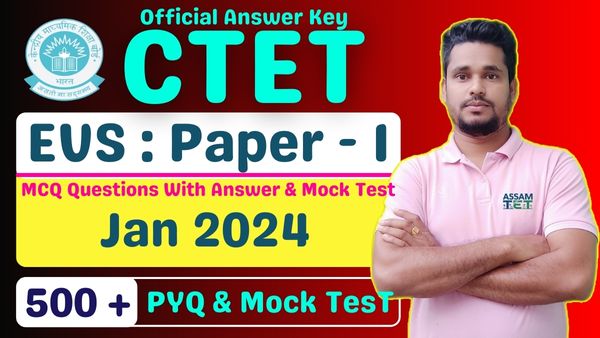
CTET Jan 2024 : EVS, Paper 1

   Download CTET Jan 2024 Paper 1 EVS with Official Answer Key PDF. Get accurate CTET Environmental Studies solutions, questions & answers. Best resource for CTET aspirants.


Follow Us

FaceBook Join Now
WhatsApp Join Now
Telegram Join Now


CTET EVS, Paper 1

     Prepare effectively for the CTET EVS Paper 1 with our comprehensive Study Materials, Mock Tests and Previous Year Questions. Our resource provides an extensive collection of practice papers designed to simulate the actual exam environment, helping you gain confidence and improve your problem-solving skills. Each mock test is crafted to cover a wide range of topics and question formats that are typically seen in the CTET EVS Paper 1, ensuring you are well-prepared for any type of question that may appear.


CTET Jan 2024 : EVS, Paper 1


PART - III / भाग - III

Environment Studies / पर्यावरण अध्ययन


Direction : Answer the following questions (Q. Nos 61 to 90) by selecting the correct/most appropriate options.
निर्देश : निम्नलिखित प्रश्नों (प्रश्न संख्या 31 से 60) के उत्तर सही/सबसे उपयुक्त विकल्पों का चयन करके दीजिए।

 
61. Which one of the following regarding Johad is correct 
Choose the correct option.
A. It is a community based rain water harvesting system.
B. It filters impurities from water.
C. It pumps groundwater into nearby wells.
D. Stores water from rivers.
 
 
62. Which of the following strategies promotes inquiry while teaching the theme ‘Food’
A. Asking students to collect pictures of various food items.
B. Demonstrating fireless cooking of sandwiches, shikanji (lemon water) etc.
C. Asking students to find out food preferences of their family members.
D. Showing pictures of various preserved food items used in different regions of India


63. An EVS teacher asks her students to think and answer “Why do we feel comfortable in woollens clothes during winter”. This question is a :
A. Convergent question
B. Analytical question
C. Hypothetical question
D. Factual question]
 
 
64. A chapter in EVS textbook of NCERT describes Wahida Prism and her experience in the Navy as a doctor. What are the reasons for including this chapter
(a) Her experience challenges gender stereotypes
(b) Her story gives a peep into the life of a medical officer in the armed forces
(c) Understanding that prism reflects 7 colours
(d) Understanding the difficulties faced by her and her ways of tackling them
A. (a), (b) and (c)
B. (b), (c) and (d)
C. (c) and (d)
D. (b), (d) and (a)
 
 
65. Alex, an EVS teacher of class 3 while introducing the theme ‘Work We Do’ helps his students to cut colourful strips of paper and weave the strips to make a mat. The edges are glued together to make a beautiful mat. Which of the following objectives should Alex help his students focus
(a) learning about colours, patterns and developing an aesthetic sense.
(b) relating the activity to weaving done by weavers.
(c) memorising the steps of making mat.
(d) choosing papers of attractive colours and learning cutting of strips perfectly.
A. (a), (b) and (d)
B. (b), (c) and (d)
C. (a), (c) and (d)
D. (a) and (c)
 
 
66. Students conduct a survey in their homes and neighbourhood to find out the number of members and approximate amount of water used in each family. What skills and processes are developed through this activity
A. Questioning, experimentation, sensitivity towards environment
B. Questioning, inferring, expression
C. Hypothesising, inferring, expression
D. Prediction, experimentation, observing


CTET Previous Year Question Papers for EVS

    Explore comprehensive solutions and answer keys for CTET EVS, Paper 1 from previous years. Our collection includes detailed question papers, solutions, and expert analysis to help you prepare effectively for the Central Teacher Eligibility Test. Access valuable resources and enhance your exam strategy with real exam questions and solutions.

CTET June 2011, Paper - 1 Click Here
CTET Jan 2012, Paper - 1 Click Here
CTET Nov 2012, Paper - 1 Click Here
CTET July 2013, Paper - 1 Click Here
CTET Feb 2014, Paper - 1 Click Here
CTET Sep 2014, Paper - 1 Click Here
CTET Feb 2015, Paper - 1 Click Here
CTET Sep 2015, Paper - 1 Click Here
CTET Jan 2016, Paper - 1 Click Here
CTET Feb 2016, Paper - 1 Click Here
CTET Sep 2016, Paper - 1 Click Here
CTET Dec 2018, Paper - 1 Click Here
CTET Dec 2019, Paper - 1 Click Here
CTET July 2019, Paper - 1 Click Here
CTET Jan 2021, Paper - 1 Click Here
CTET Dec 2022, Paper - 1 Click Here
CTET Jan 2022, Paper - 1 Click Here
CTET Aug 2023, Paper - 1 Click Here
CTET Jan 2023, Paper - 1 Click Here
CTET Jan 2024, Paper - 1 Click Here
CTET July 2024, Paper - 1 Click Here
CTET Dec 2024, Paper - 1 Click Here


67. Doctors prescribe blood test for patients to confirm malaria. Blood test is done to
A. Check for haemoglobin in blood
B. Check iron in blood
C. Check for eggs of female anopheles mosquitoes in blood
D. Check for microbes in blood
 
 
68. Consider the following statements about beehives
(a) Honey bees live in beehives. Every beehive has one queen Bee that lays eggs.
(b) There are only a few males bees in the hive which have special roles as workers.
(c) Most of the female bees in the hive are worker bees who work all the day in making the hive and also looking after the baby bees.
(d) The worker bees fly around Litchi flowers in search of nectar for honey.The correct statements are :
A. (a) and (b)
B. (c) and (d)
C. (a) and (c)
D. (a) and (d)
 
 
69. Textbooks of EVS should reflect the recommendation of NCF 2005 of linking students’ life at school to their life outside. This implies :
A. Students are compelled to memorise few important concepts of EVS.
B. Textbook is the only source of knowledge.
C. Textbooks supports students to construct knowledge through all the given activities.
D. Teachers need to use textbooks as one of the teaching learning resource.
 
 
70. It has been observed by bird watchers that there is a peculiar species of birds. The male bird make their own nests and the female bird looks at all the nests and selects the one she likes the best and decides in which nest to lay her eggs. The name of the bird is :
A. Tailor bird
B. Weaver bird
C. Indian Robin
D. Sun bird
 
 
71. Read the following Statement (A) and Statement (B) below and choose the correct option :
(A) : About 4700 years ago, some of the earliest cities flourished on the banks of river Indus and its tributaries.
(B) : About 1500 years ago, cities developed on the banks of the Ganga and its tributaries.
A. Both (A) and (B) are true.
B. Both (A) and (B) are not true.
C. (A) is true but (B) is false.
D. (A) is false but (B) is true.


72. Which of the following best reflects child -centred strategies in teaching EVS at primary level
(a) Discussion
(b) Demonstration
(c) Lecture
(d) Survey
A. (a) and (b)
B. (b) and (c)
C. (c) and (d)
D. (a) and (d)
 
 
73. Pochampalli is famous district for its beautifully designed bright coloured sarees and for the special kind of weave which is also called Pochampalli. It is a part of :
A. Tamil Nadu
B. Karnataka
C. Maharashtra
D. Telangana
 
 
74. Seema, an EVS teacher organised a field trip to zoo for her students. Which of the following are the most appropriate objectives of the trip to the zoo
(a) Recall names of animals in the zoo
(b) To relate concepts related to animals
(c) To promote process skills
(d) Assessment of students’ learning at the zoo
A. (a), (b) and (c)
B. (b), (c) and (d)
C. (a), (c) and (d)
D. (a) and (b)
 
 
75. An EVS teacher taught about animals to her students and ask them to do the following task
(a) Write names of various animals around them
(b) Observe activities of different animals
(c) Classify animals into categories based on observations
(d) Define the term ‘Animal’
Which of the above is NOT appropriate for students of primary level as per the nature of EVS at primary level
A. (a) and (c)
B. (b) and (c)
C. Only (c)
D. Only (d)
 
 
76. The territorial states of Haryana are :
A. Himachal Pradesh, Rajasthan, Uttar Pradesh
B. Uttar Pradesh, Uttarakhand, Madhya Pradesh
C. Himachal Pradesh, Punjab, Bihar
D. Bihar, Punjab, Uttar Pradesh


YouTube Channel

Assam TET Academy Subscribe Now
Career Niyog Subscribe Now


77. Read statements (A) and (R) properly and then answer the following questions.
(A) : Silkworm can find his female worm from many kilometers away by her smell.
(R) : Some female insects release ‘Pheromones’ which can be recognised by their males by smell. Choose the correct answer :
A. Both (A) and (R) are correct and (R) explains (A).
B. Both (A) and (R) are correct but (R) does not explains (A).
C. (A) is correct but (R) is incorrect.
D. (A) is incorrect but (R) is correct.
 
 
78. Read the following statements carefully :
Statement (I) : EVS syllabus is divided into 6 themes Water, Relationships, Food, Transport, Shelter, and How things work.
Statements (II) : The themes of EVS are close to children’s life.
A. Both Statements (I) and (II) are true
B. Both Statements (I) and (II) are false
C. Statement (I) is true and Statement (II) is false.
D. Statement (I) is false and Statement (II) is true
 
 
79. Comprehensive evaluation means holistic way of evaluating a student. The ways in which an EVS teacher can assess her students for comprehensive evaluation in EVS are :
A. Teachers’ observation, portfolio
B. Half yearly and annual exams
C. Rating scale during assessment of activities
D. All
 
 
80. Read the following statements carefully and choose the correct options :
Statement (A) : Xylem transports water and minerals from roots to rest of the plant.
Statement (B) : Phloem translocates food from leaves to various parts of the plant.
A. Both (A) and (B) are true
B. Both (A) and (B) are false
C. (A) is true, but (B) is false
D. (A) is false, but (B) is true
 
 
81. Ravi took some water in a glass. He puts a lemon in it. Then, he keeps adding a lot of salt into the water, half a spoon at a time. After some time, he notices that
A. Lemon sinks in water.
B. Lemon floats in water.
C. Lemon splits in water.
D. Lemon remains mid-way in glass of water.


Previous Year Question Papers For CTET, Paper I

    Explore comprehensive solutions and answer keys for CTET EVS, Paper 1 from previous years. Our collection includes detailed question papers, solutions, and expert analysis to help you prepare effectively for the Central Teacher Eligibility Test. Access valuable resources and enhance your exam strategy with real exam questions and solutions.

CDP Click Here
Mathematics Click Here
EVS Click Here
English Click Here
Hindi Click Here
Assamese Click Here
Bengali Click Here


82. Which of the following sets depicts the themes of EVS at primary level
A. Weather, Water, Travel
B. Food, Material, Shelter
C. Family and Friends, Travel, Natural resources
D. Shelter, Travel, Things we make and do
 
 
83. Which one of the following statements regarding Al-Biruni is NOT true 
Choose the correct answer.
A. The place that Al-Biruni came from is now called Uzbekistan.
B. More than a thousand years ago, he came to India.
C. He did not write anything about ponds in India.
D. He has praised the making of ponds in India.
 
 
84. Consider the following statements (A) and (B).
Statement (A) : Bora is a common variety of rice used in Assam.
Statement (B) : Paddy grows well in clayey soil and requires a lot of water.
Select the correct code from the following.
A. (A) and (B) both are correct
B. (A) and (B) both are wrong
C. (A) is correct but (B) is wrong
D. (A) is wrong but (B) is correct
 
 
85. What is the mass of an object with a density of 12 g/ml and a volume of 3 ml
A. 15 g
B. 24 g
C. 36 g
D. 4 g
 
 
86. You wish that students learn by peer-learning strategies. Which strategy will you adopt to form groups
A. Make a roll number-wise groups of 4/5 students
B. Make a homogeneous group of students according to their scores in examination
C. Make a heterogeneous group based on participation and cooperation
D. Form a group of 5 students of same gender and socio-economic background


Previous Year Question Papers For CTET, Paper II

    Explore comprehensive solutions and answer keys for CTET Paper 2 from previous years. Our collection includes detailed question papers, solutions, and expert analysis to help you prepare effectively for the Central Teacher Eligibility Test. Access valuable resources and enhance your exam strategy with real exam questions and solutions.

CDP Click Here
Maths & Science Click Here
Social Stuies Click Here
English Click Here
Hindi Click Here
Assamese Click Here
Bengali Click Here


87. Which one of the following statements regarding Ghadsisar Lake is NOT true ?
A. King Ghadsi of Jaisalmer got it made.
B. It was built around 650 years ago.
C. It was connected with nine lakes.
D. It is in use till today.
 
 
88. Assertion : The theme ‘Family and Friends’ is a major theme in EVS and ‘Plants and Animals’ are presented as a subtheme of ‘Family and Friends’.
Reason : The interdependence of human beings and other forms of life is highlighted through themes.
A. Both the assertion and reason are correct and the Reason is the correct explanation of the Assertion.
B. The assertion and the reason are correct but the Reason is not the correct explanation of the Assertion.
C. Assertion is true but the reason is false.
D. The statement of the assertion is false but the reason is true.
 
 
89. Read the given statements carefully and choose the correct option.
Assertion (A) : We can cook food easily at sea level as compared to higher altitudes.
Reason (R) : At high altitudes, boiling point of water increases.
A. Both (A) and (R) are true and (R) is the correct explanation of (A).
B. Both (A) and (R) are true but (R) is not the correct explanation of (A).
C. (A) is true but (R) is false.
D. (A) is false but (R) is true
 
 
90. Nina, an EVS teacher of class 5 gives a group assignment to her students that they have to visit nearby agricultural farms and find out information about the implements used by farmers during agriculture and the type of crops they grow. They also have to collect photographs and prepare a report. What process skills and learning indicators are involved here
A. Questioning, Expression, Inferring
B. Questioning, Experimentation, sensitivity towards environment
C. Hypothesising, inferring, expression
D. Prediction, experimentation, observing


CTET Previous Year Question Papers for EVS
June - 2011 Jan - 2012 Nov - 2012
July - 2013 Feb - 2014 Sep - 2014
Feb - 2015 Sep - 2015 Jan - 2016
Feb - 2016 Sep - 2016 Dec - 2018
Dec - 2019 July - 2019 Jan - 2021
Dec - 2022 Jan - 2022 Aug - 2023
Jan - 2023 Jan - 2024  July - 2024
Dec - 2024


Author of the Post
Jahidul Islam
CEO : Jahidul Islam (Moina)
B.sc, D.El.ED & B.Ed
Assamtetacademy@gmail.com


Study Materials (AssamTET.com)

Assam TET-LP Assam TET-UP CTET - Paper 1
CTET - Paper 2 ADRE Grade 3 ADRE Grade 4
Assam Police D.El.Ed Class 10
Asaam TET-GT Assam TET-PGT Class 12


Share this post

Explore Our Categories

Follow us on

Contact Information

Office Address:

Darrang, Assam 784514

Email: assamtetacademy@gmail.com

Phone: 9954060750

Follow Us

Design & Developed by Assam TET Academy

Copyright © 2026 Assam TET | All rights reserved